Thursday 17th September 2026
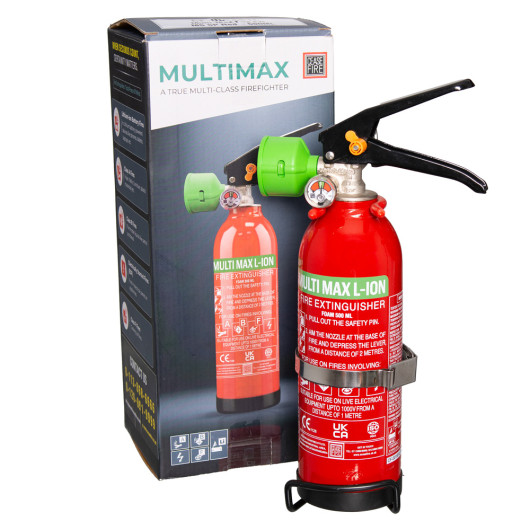
Ceasefire’s 6-litre and 9-litre MultiMax L-Ion foam extinguishers have received BSI compliance certification for lithium-ion battery fires. They are the first extinguishers to receive this particular BSI certification.
Both the 6-litre MultiMax L-Ion and 9-litre MultiMax L-Ion are available through Safelincs. The certification provides independent evidence of their performance under defined lithium-ion battery fire test conditions, helping those responsible for fire safety make informed equipment choices.
Estimated reading time: 3 minutes
What Has Been Certified?
BSI Certificate CNF 807785 covers the CF-001537 6-litre and CF-001538 9-litre stored-pressure foam extinguishers, which use Ceasefire’s CF Green 100% extinguishing agent.
The certificate lists lithium-ion suitability of 600Wh under NTA 8133:2021+A1:2025.
Watt-hours describe a battery’s energy capacity. When selecting equipment for devices such as e-bikes or cordless power tools, check the battery’s capacity and the manufacturer’s guidance. This certification does not establish suitability for electric vehicle batteries or larger home battery storage systems, and should not be treated as blanket coverage for multiple batteries stored together.
Why Lithium-Ion Fires Need Specific Testing
Lithium-ion batteries can enter thermal runaway, a process in which a cell generates heat uncontrollably. That heat can cause neighbouring cells to fail too, allowing the fire to spread through a battery pack.
These fires can develop rapidly, as well as producing toxic smoke and reigniting after visible flames have been extinguished.
The conventional portable extinguisher standard, EN 3-7, does not include a designated lithium-ion battery fire test. NTA 8133, a Dutch Technical Agreement published by NEN, provides a specific method for assessing extinguisher performance on lithium-ion battery fires.

How Is This Different From Existing Extinguisher Approvals?
An extinguisher’s conventional approvals don’t automatically demonstrate its performance on lithium-ion battery fires. BSI’s lithium-ion Compliance Certificate provides separate evidence from testing under specified battery fire conditions.
Other extinguishers already hold NTA 8133 approval. Ceasefire’s announcement concerns this particular BSI compliance certification, rather than being the first extinguisher tested against lithium-ion battery fires.
What Does BSI Compliance Certification Demonstrate?
BSI’s compliance certification provides independent verification of performance claims through testing under defined conditions. The certificate documents the battery configurations, chemistries and capacities covered by that assessment.
It provides evidence for the specified products and test conditions, rather than a guarantee of performance against every lithium-ion battery fire.
In its white paper on lithium-ion fire suppression, BSI explains that compliance certification offers an interim route to verify product performance while national and European standards are developed.
What This Means for Homes and Workplaces
For premises where lithium-ion batteries are stored or charged, this certification provides useful evidence to support the selection of lithium-ion fire extinguishers. The choice of extinguisher should still reflect the specific batteries present and the findings of the fire risk assessment.
Certification does not change the emergency advice. If a lithium-ion battery begins to smoke or catches fire, get out immediately, raise the alarm and call 999. Stay out and do not attempt to tackle the fire yourself. This follows London Fire Brigade’s guidance.
Explore the Ceasefire MultiMax L-Ion range at Safelincs, or contact our team for help choosing equipment for the batteries stored or charged on your premises.