Friday 8th May 2026
You don’t get long to make decisions in a fire. Reach for the wrong extinguisher and you could make a dangerous situation significantly worse. That’s the whole point of fire extinguisher colours: a visual code that tells you what’s inside each cylinder and which fires it can tackle. This guide covers fire extinguisher colours and their meanings, from the dry powder fire extinguisher colour to CO2, foam and wet chemical. It’s a detailed explanation of UK fire extinguisher colour coding for every type you’ll find on UK premises, covering classes, ratings, location and what the law requires. Browse our fire extinguisher range to find the right fit for your site.
Reading time: 6 minutes
Key takeaways:
- All modern UK fire extinguishers comply with BS EN 3: a signal red body with a coloured band identifying the agent inside.
- The dry powder fire extinguisher colour is blue; dry powder extinguishers cover Class A, B, C and electrical fires.
- The colour change came in 1997 when BS EN 3 replaced fully coloured bodies with the red body plus coloured band system.
- Extinguisher selection must always be based on a fire risk assessment, not colour alone.
- Our P50 extinguishers need no engineer visits for ten years, just a recorded annual inspection by your team.
Why Is Fire Extinguisher Colour Coding Important?
Most people don’t give fire extinguishers a second thought until a fire breaks out. Then every second matters.
The Danger of Choosing the Wrong Type
Using CO2 on a class A fire – it can make it significantly worse.
Directing foam at a burning chip pan can cause a violent flare-up.
These aren’t remote possibilities; they’re documented risks that the colour coding system is designed to prevent.
The situation and visibility of fire extinguisher coding is what makes it so effective. A colour panel stands out against a signal red body even in a smoke-filled room. When conditions are at their worst, you’re not reading instructions. You’re looking for a colour. That split-second clarity is the whole design intent.
Your Legal Duty as the Responsible Person
Under the Regulatory Reform (Fire Safety) Order 2005, the responsible person for any commercial premises must provide appropriate fire fighting equipment, correctly positioned and properly maintained. Understanding fire extinguisher colours and their meanings is part of meeting that duty.

Why Did the Fire Extinguisher Colours Change?
How the Old System Worked
Before 1997, UK fire extinguishers were colour-coded by painting the entire cylinder body. Blue signified dry powder. Black meant CO2. Cream identified foam.
What BS EN 3 Changed in 1997
The British and European Standard BS EN 3 replaced the old approach. All new fire extinguishers were standardised to a signal red body. Red is the colour most strongly associated with danger, and it stands out clearly in low light and smoke-filled conditions.
The identifying colour moved to a band or panel covering 5-10% of the extinguisher’s surface, positioned above the printed instructions. This shift is at the heart of an explanation of UK fire extinguisher colour coding: the body says ‘this is fire fighting equipment’, the coloured band says ‘this is what’s inside’. Together, they communicate everything you need in under a second.
Types of UK Fire Extinguishers and Their Colours
To make sense of the different colours of fire extinguishers, it helps to understand the different classes of fire first. The fire classification system groups fires by their fuel type, and each class requires a different extinguishing approach.
Here’s a summary of the different fire extinguisher colours (UK) alongside the classes each type covers:
| Colour band | Type | Classes covered |
|---|---|---|
| Red (no additional band) | Water | Class A |
| White | Water mist | Class A, B, F and electrical |
| Cream | Foam | Class A, B, electrical (and sometimes F) |
| Blue | Dry powder | Class A, B, C and electrical |
| Black | CO2 | Class B and electrical |
| Yellow | Wet chemical | Class A, F and usually electrical |
The fire classes break down as follows. Each is defined by its fuel, which determines which agents can safely tackle it:
- Class A: Solid combustibles, including wood, paper, textiles and coal
- Class B: Flammable liquids such as petrol, paint, diesel and solvents
- Class C: Flammable gases, including propane, butane, acetylene and natural gas
- Class D: Combustible metals, requiring specialist extinguishers only
- Class F: Cooking oils and fats heated to high temperatures
Water Extinguishers: Signal Red, No Additional Band
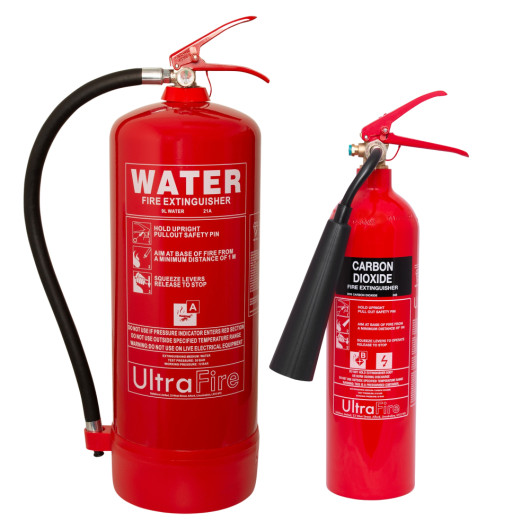
Water extinguishers have a solid signal red body with no additional colour panel. They’re the most common type across UK premises and cover Class A fires involving solid combustibles. Water extinguishers that have been di-electrically tested to BS EN3 are also suitable for use on live electrical equipment up to 1000 volts.

Water Mist Extinguishers: White Label
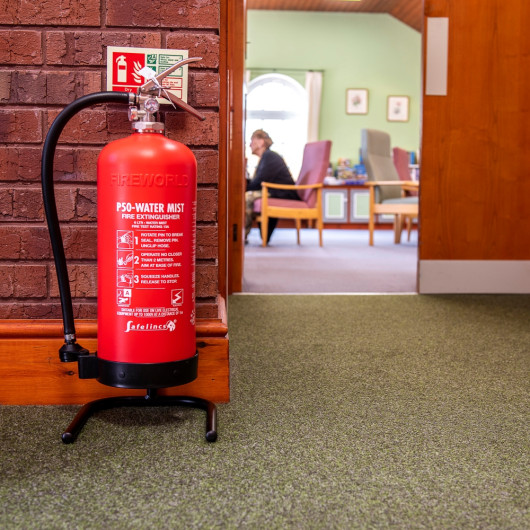
A white label on a signal red body identifies a water mist extinguisher. These use de-ionised water dispensed as a fine mist, making them effective on Class A, B, F and electrical fires. Our water mist extinguishers are a strong choice for premises that want broad coverage without carrying several different extinguisher types.
Foam Extinguishers: Cream Panel
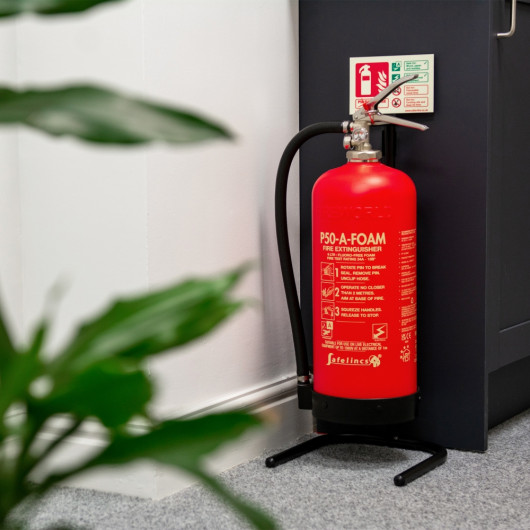
Foam extinguishers carry a cream panel on their signal red body and cover Class A and Class B fires, and in some cases class F. Most modern models have been dielectrically tested, making them suitable near live electrical equipment.
Dry Powder Extinguishers: Blue Panel
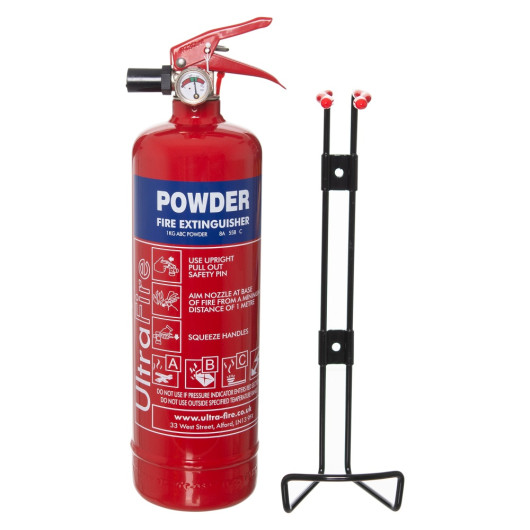
Blue (dry powder extinguishers) offer the widest fire class coverage of any standard type. There’s a full breakdown of the dry powder fire extinguisher colour, uses and limitations in the section below.
CO2 Extinguishers: Black Panel
A black panel identifies a CO2 extinguisher. These cover Class B fires and electrical fires, and they leave no residue behind, making them practical for server rooms and areas containing sensitive equipment. They should not be used in confined spaces due to the risk of oxygen displacement.

Wet Chemical Extinguishers: Yellow Panel
A yellow panel marks a wet chemical extinguisher. These are engineered specifically for Class F fires involving cooking oils and fats. For commercial kitchens with deep fat fryers holding more than three litres of oil, a wet chemical extinguisher is a legal requirement under the Regulatory Reform (Fire Safety) Order 2005. Most models also cover Class A fires.
What Colour Is a Dry Powder Fire Extinguisher in the UK?
he Dry Powder Fire Extinguisher Colour Code
The dry powder fire extinguisher colour is blue. To be precise: dry powder fire extinguishers are signal red with a blue panel above the printed instructions. This is the dry powder fire extinguisher colour code under BS EN 3, and it applies across the range, from compact 1 kg units to 9 kg cylinders.
The dry powder fire extinguisher colour label, colour band and colour panel all refer to the same identifying feature: a blue colour panel or band that tells you the cylinder contains dry powder agent. Dry powder extinguishers have a blue label because of what’s inside. Typically ABC multipurpose powder, which works by interrupting the chemical chain reaction that sustains a fire and creating a barrier between fuel and oxygen.
That mechanism is what makes blue-labelled dry powder extinguishers effective on Class A, B, C and electrical fires, giving them the broadest standard fire class coverage available.
Dry Powder Fire Extinguisher Guide: Colours and Uses
This dry powder fire extinguisher guide, colours and uses section covers the key details on where these extinguishers perform well.
Dry powder extinguishers are commonly found in:
- Vehicles and mobile plant, including vans, HGVs, forklifts and site machinery
- Garages, workshops, petrol forecourts and paint stores with flammable liquid storage
- Agricultural and construction settings with mixed fuel and solid material risks
- Open outdoor industrial environments where flammable gases are the primary hazard
That broad fire class coverage is why they remain a default choice in vehicle and industrial settings. But there are real trade-offs worth knowing before you buy.
When Dry Powder Isn’t the Right Extinguisher
On discharge, dry powder creates a dense cloud. In an enclosed space, visibility drops fast and inhalation becomes a risk. The residue left behind is also difficult to clean up and can damage electronic equipment and precision machinery.
For most occupied indoor premises, water mist or foam extinguishers are a safer fit. Our water mist range covers a broad range of fire types without the visibility or contamination issues that come with powder. If your risk assessment covers an office, school or care environment, powder is rarely the right answer.
Fire Extinguisher Standards and Ratings
Classes, Colour Coding, Rating, Location and Maintenance: What You Need to Know
Understanding the colours of fire extinguishers is one part of the picture. The other part is knowing what ratings, standards and maintenance requirements mean for your premises.
Fire Ratings: What the Numbers Tell You
Extinguishers designed for Class A, B or F fires carry a fire rating shown as a number and letter, such as 13A or 55B. The number represents the size of fire the extinguisher can handle under test conditions; a higher number means it can tackle a larger fire. Any extinguisher that carries the electrical symbol has been di-electrically tested and certified for use on live electrical equipment up to 1000Volts.
BS EN 3 Compliance: What to Look For
All modern UK fire extinguishers must comply with BS EN 3. Look for the BSI Kitemark on the label, and on newer units, the UKCA mark. These confirm the extinguisher has been tested to a defined performance standard and that its colour coding is consistent with the system described throughout this guide.
Positioning Your Extinguishers
Position extinguishers on exit routes where they’re visible and accessible. Mount them at approximately 1.5 metres from the floor to the handle. In larger premises, identification signs can help staff and visitors locate the right unit quickly under pressure.
Servicing and Maintenance
Annual Servicing to BS 5306-3
All steel fire extinguishers require annual servicing by a qualified engineer, in line with BS 5306-3. Water, foam and powder types need discharge and refill every five years. CO2 units need refurbishment at the ten-year mark.
Our P50 Range: No Annual Engineer Visits for Ten Years
Our P50 extinguishers work on a different schedule. They need no engineer visits for a full ten years, just a monthly visual check and an annual recorded inspection carried out by your own team. That removes a recurring cost and a recurring admin task, which makes compliance significantly simpler for smaller businesses and landlords managing multiple sites.
Not sure which colours of fire extinguishers your premises needs, or how many units are required? A fire risk assessment is the right place to start. We offer BAFE-certified extinguisher surveys across the UK.
All information correct at time of posting.