Wednesday 6th May 2026
Estimated reading time: 6 minutes
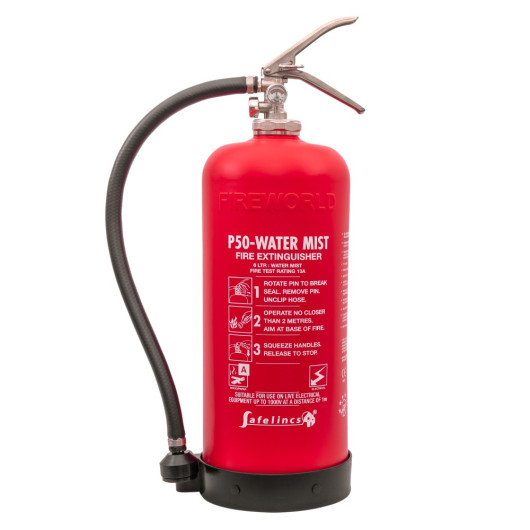
Water mist extinguishers use de-ionised water and microscopic droplets to tackle multiple fire types. They’re ideal for offices, schools and homes where you want minimal cleanup and environmental safety. Traditional extinguishers (foam, powder, CO2 and standard water units) have protected UK properties for decades. Each one specialises in specific fire classes, but you’ll often need multiple units for full coverage.
The key difference? Water mist extinguishers handle Class A, B, C and small F fires plus electrical equipment in a single unit with zero toxic residue. Traditional extinguishers typically require you to pair multiple types, and some contain harmful PFAS chemicals or create messy cleanup challenges.
What Are the Key Strengths and Practical Benefits of Each Extinguisher Type?
Water Mist Extinguisher Strengths
Multi-Class Fire Coverage
Water mist extinguishers tackle Class A (wood, paper, textiles), Class B (flammable liquids), Class C (gases), small Class F fires (up to 5F rating) and fires involving live electrical equipment up to 1000V. One water mist unit often replaces multiple traditional extinguishers.
Superior Fire Suppression Technology
The patented supersonic nozzle creates over 22 billion microscopic water droplets (10 to 100 microns) from just 1 litre of water. These tiny particles vaporise rapidly when they contact flames, creating a steam barrier that displaces oxygen. The enlarged surface area absorbs heat faster than conventional water streams.
Zero Environmental Impact
Minimal Water Damage and Residue
The fine mist penetrates burning materials efficiently but uses significantly less water than traditional extinguishers. After you discharge it, there’s virtually no residue to clean up. Minimal water damage to property, electronics or stock.
Electrical Safety
Traditional Extinguisher Strengths
Specialised Fire Class Performance
Proven Reliability Track Record
Higher Fire Ratings Available
Cost-Effective Initial Purchase
Impact on Your Fire Safety Strategy
For Water Mist Extinguishers:
- Simplify compliance by reducing the number of extinguisher types you need on premises
- Lower long-term costs with service-free P50 models (no annual servicing for 10 years)
- Protect property and equipment from water damage during fire suppression
- Support environmental sustainability commitments and eliminate PFAS exposure
- Provide safer fire protection in areas with vulnerable populations
For Traditional Extinguishers:
- Maintain established fire safety protocols familiar to trained personnel
- Access specialist protection for high-risk environments (large commercial kitchens, outdoor storage)
- Leverage lower initial investment for basic fire coverage
- Use proven solutions accepted by all insurance providers
Ready to Upgrade Your Fire Protection?
Discover how water mist extinguishers can simplify your fire safety strategy and protect the environment. Whether you’re replacing traditional AFFF foam units or establishing new fire protection, we offer expert guidance, free site surveys for P50 service-free extinguishers and award-winning customer service.
Browse our complete range of fire extinguishers or speak with our fire safety specialists to find the perfect solution for your property.
How Do Water Mist and Traditional Extinguishers Compare Feature by Feature?
| Feature | Water Mist Extinguishers | Traditional Extinguishers |
|---|---|---|
| Fire Class Coverage | Class A, B, C, small F (up to 5F), Electrical | Varies by type: Water (A only), Foam (A, B, Electrical), Powder (A, B, C, Electrical), CO2 (B, Electrical), Wet Chemical (F) |
| Electrical Safety | ✓ Safe up to 1000V (1m distance) | CO2 & Powder: ✓ SafeFoam: ✓ Safe (some models)Water: ✘ Dangerous |
| Environmental Impact | 100% eco-friendly, no chemicals | Water: ✓ Eco-friendlyFoam (AFFF): ✘ Contains PFASPowder & CO2: Partial concerns |
| Residue After Use | ✓ Virtually none | Water: ✓ MinimalFoam: ✘ Messy cleanupPowder: ✘ Very messyCO2: ✓ None |
| Annual Servicing | Traditional models: RequiredP50 models: ✘ Not required | ✓ Required by qualified technician |
| Water Damage Risk | ✓ Minimal | Water/Foam: Moderate to highPowder/CO2: ✓ Minimal |
| Indoor Use Safety | ✓ Excellent | Water: ✓ SafeFoam: ✓ SafePowder: ✘ Visibility/respiratory issuesCO2: ⚠ Confined space risks |
| Typical Warranty | 5 years (standard models)10 years (P50 models) | 5 years standard |
| Multiple Units Required | ✘ Often replaced by single unit | ✓ Usually 2 to 3 types needed |
| Suitable for Homes | ✓ Ideal | Varies by type |
| Starting Price (6-litre unit) | From £82.99 inc VAT | Varies by type and model |
| Discharge Time | Longer, sustained | CO2: Very shortOthers: Standard |
| Toxicity | ✓ Non-toxic | Water: ✓ Non-toxicFoam (AFFF): ✘ ToxicPowder: ⚠ Mild irritantCO2: ⚠ Asphyxiation risk |
| Outdoor Durability | P50 models: ✓ Corrosion-proofMetal models: Standard | Standard metal construction |
| Re-ignition Prevention | ✓ Excellent cooling effect | Water/Foam: ✓ GoodCO2: ✘ Risk of re-ignitionPowder: Moderate |
Why Does Choosing Between Water Mist and Traditional Extinguishers Matter?
This decision impacts your property protection, running costs, environmental responsibility and legal compliance for years to come.
The UK is phasing out AFFF foam extinguishers due to harmful PFAS chemicals. The manufacture of AFFF foam fire extinguishers is expected to be banned before the end of 2026. You’re now facing a choice: embrace water mist technology or maintain combinations of traditional units.
Water mist extinguishers represent the future of fire safety. They offer broader fire class coverage, eliminate toxic chemical exposure, reduce water damage dramatically and potentially lower long-term costs through service-free P50 models. Traditional extinguishers provide proven reliability and specialist protection for specific high-risk environments.
Understanding the strengths, limitations and total cost of ownership for each option helps you select fire protection that matches your property’s unique risks, occupancy needs and sustainability commitments. You’ll meet all UK fire safety regulations too.
Not Sure Which Extinguisher Is Right for Your Property?
Every building has different fire risks, and choosing between water mist and traditional extinguishers isn’t always straightforward. Our fire safety specialists can assess your requirements, explain your options and recommend the most cost-effective solution for your premises.
Whether you’re replacing outdated AFFF foam units ahead of the upcoming ban, looking to cut long-term servicing costs with P50 service-free extinguishers, or simply need guidance on meeting UK fire safety regulations, we’re here to help.
Speak to our expert team today on 0800 612 6537 for instant advice. We’ll help you find the right fire protection without the guesswork.
Frequently Asked Questions
Can water mist extinguishers fully replace traditional extinguishers in my building?
In most settings, yes. Water mist extinguishers cover Class A, B, C and small Class F fires as well as electrical equipment up to 1000V, so a single unit can often replace a water and CO2 combination. However, for large commercial kitchens with deep fat fryers rated above 5F, you’ll still need a dedicated wet chemical extinguisher. If you’re unsure, our team can advise on the right setup for your specific risks.
Are water mist extinguishers compliant with UK fire safety regulations?
Yes. Our water mist extinguishers are manufactured, tested and certified to BS EN3, the European and British standard for portable fire extinguishers. They are accepted by fire risk assessors and insurance providers. The P50 service-free models are also Kitemarked by BSI and have been approved by all major UK insurance companies.
How much can I save by switching to P50 service-free extinguishers?
P50 extinguishers require no annual third-party servicing and no discharge and refill after five years, just a simple visual inspection by a trained member of your team. Over a 10-year period, many organisations save over 50% on their extinguisher maintenance costs compared to traditional steel units. Visit our P50 savings calculator to get an instant estimate based on your current number of extinguishers.
What should I do if I still have AFFF foam extinguishers on site?
AFFF foam extinguishers contain harmful PFAS chemicals and the manufacture of these units is expected to be banned in the UK before the end of 2026. We strongly recommend replacing them now to stay ahead of legislation and avoid rising disposal costs. In most cases, water mist or fluorine-free eco-foam extinguishers are suitable direct replacements. Contact our team for a free recommendation.
Do I still need my extinguishers serviced annually if I switch to water mist?
It depends on the model. Standard steel water mist extinguishers still require an annual service by a qualified technician, just like any other traditional extinguisher. However, P50 water mist extinguishers are completely service-free for 10 years and only need an annual visual inspection carried out by a member of your own staff. Read more about how P50 extinguishers are different.
How do I know which type and how many extinguishers my building needs?
The type and number of extinguishers depends on your building’s size, layout and the fire risks identified in your fire risk assessment. As a general rule, users should not have to travel more than 30 metres to reach a Class A extinguisher. Our specialists can carry out a site survey to ensure you have the right coverage and are fully compliant with current British Standards. Call us on 0800 612 6537 to arrange one.
All information correct at time of posting.