Wednesday 13th May 2026
Reading time: 7 minutes
Key takeaways:
- Class F fires are fires involving cooking oils or fats heated beyond their ignition point.
- Class F fires usually occur in kitchens and can escalate within seconds.
- Never use water on a class F fire.
- Wet chemical extinguishers are the only extinguisher type rated for class F.
- Class F fire extinguishers have a yellow label and come in sizes for both domestic and commercial kitchens.
A pan of oil takes minutes to go from safely heating to violently ablaze. What is a Class F fire? Class F fires are among the fastest-escalating hazards in any kitchen, and the instinct most people have when a fire starts, reaching for water, is exactly the wrong response. That mistake has caused more injuries than the fire itself. This guide covers class F fire explained from the ground up. You’ll learn how to identify and extinguish class F fires safely and which wet chemical fire extinguishers you need close to hand. Whether you manage a commercial kitchen or simply want to be prepared at home, you’ll find practical guidance here that could make a real difference.
What Is a Fire Extinguisher Class?
Why Fire Classifications Matter in the UK
Before getting into class F, it helps to understand the bigger picture.
What are fire classifications?
A fire class is a standardised category that describes the type of fuel involved in a fire. Understanding the different classes and types of fire in the UK is fundamental to choosing the right extinguisher. It’s also what helps you respond correctly under pressure, when there’s no time to read the label.
In the UK, fire classifications follow BS EN 2, the European standard adopted across Great Britain. Each class covers a different category of burning material, and each demands a different extinguishing approach. Using the wrong extinguisher can make a fire dramatically worse.
Class F: this classification is used for materials that are easily flammable at extreme temperatures, specifically cooking oils and fats. It’s a distinct category precisely because cooking oils behave very differently to standard flammable liquids.
The Class F Fire Rating: What the Label Tells You
Fire extinguisher class ratings appear on the body of every extinguisher. For wet chemical extinguishers designed for cooking fires, you’ll see a fire extinguisher class F rating alongside a number. A 25F rating means the extinguisher was tested against a smaller test fire than a 75F model. Understanding these ratings helps you match the right product to the scale of your kitchen hazard, and that’s a decision worth making before you ever need it.
How Many Classes of Fire Are There?
A Quick Guide to UK Fire Classes
How many classifications of fire are there? In the UK, five main classes exist under BS EN 2, covering the range of fuels most likely to be encountered in a fire. Each of these classes of fire requires specific extinguishing methods, which is exactly why fire extinguisher types and uses vary as much as they do.
| Fire Class | Fuel Type | Common Fuels |
|---|---|---|
| Class A | Solid organic materials | Wood, paper |
| Class B | Flammable liquids | Petrol, paint |
| Class C | Flammable gases | Propane, butane |
| Class D | Combustible metals | Lithium, magnesium |
| Class F | Cooking oils and fats | Vegetable oil, lard |
Electrical fires sit outside this classification in the European system. Instead, individual extinguishers are tested and labelled for safe use near live electrical equipment.
It’s worth noting that the types of fire extinguisher available in the UK broadly map onto these classes. What works on a timber fire can be dangerous on a cooking oil fire. And that’s not an overstatement. With that context in place, let’s look at what makes class F fires so distinct.
What Are Class F Fires?
The Temperature That Triggers a Class F Fire
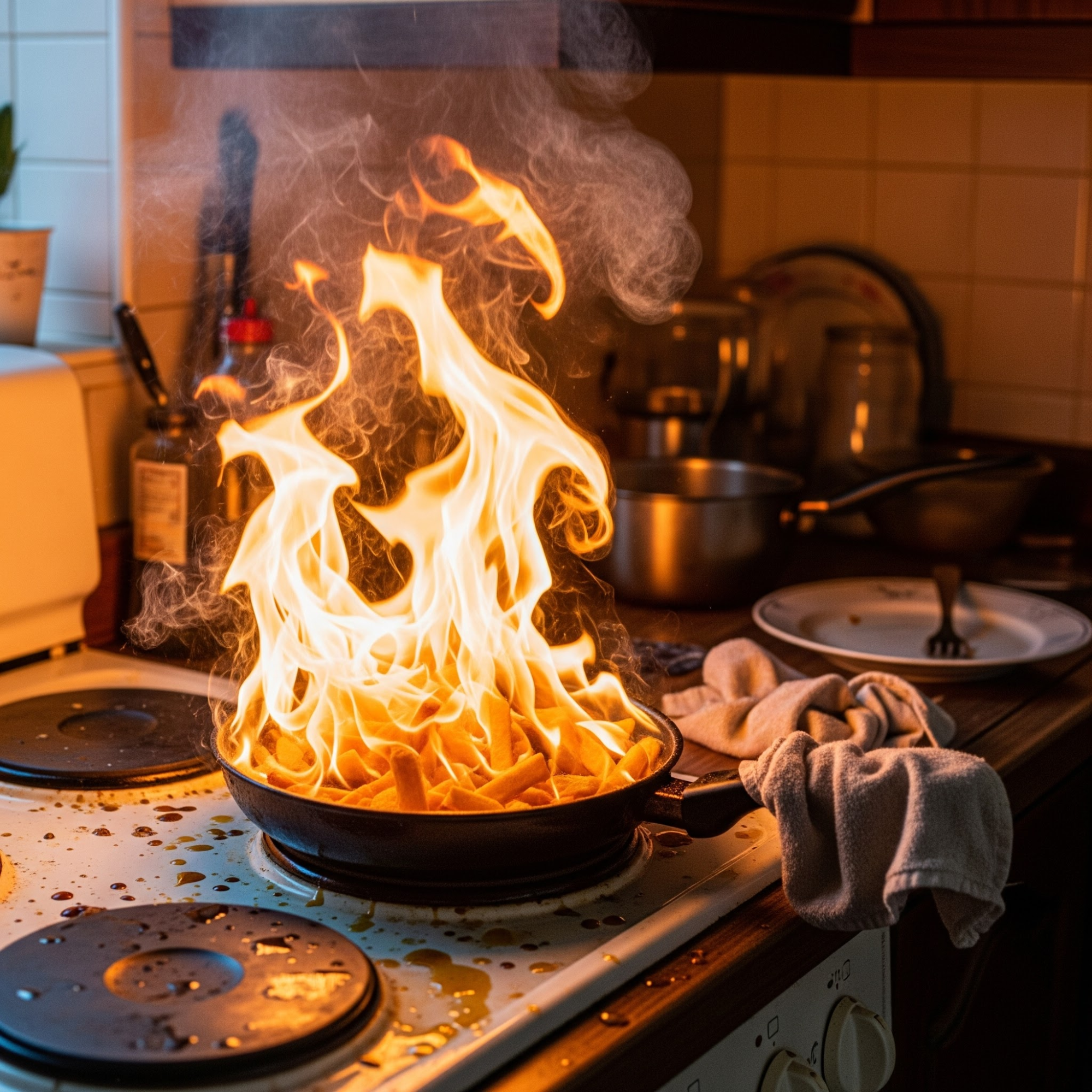
What are class F fires? Class F fires are fires involving cooking oils or fats. More specifically, they involve oils heated to extreme temperatures in a cooking environment, which is what makes them so different from other fire types.
At room temperature, cooking oil poses very little fire risk. As heat builds, the oil reaches its flash point: the temperature at which vapours near the surface can ignite if a spark or flame is present. Keep heating and it reaches the point at which it ignites without any external source at all. For most cooking oils, the class F fire temperature at this threshold sits somewhere between 290°C and 340°C, depending on the oil type. A domestic hob can reach this in minutes with unattended oil in the pan.
Class F fires are fires involving fats that have exceeded this threshold, with cooking oils reaching auto-ignition temperatures in excess of 340°C. Dense smoke, intense heat and a severe risk of burns follow almost immediately.
Why Class F Fires Are Especially Dangerous
The key aspects of class F fires aren’t always obvious until you understand what’s happening at a chemical level.
These fires don’t behave like other kitchen fires. For one thing, they can reignite after appearing to be out, because the oil beneath the surface stays extremely hot long after visible flames are gone. For another, water turns to steam on contact with burning oil at those temperatures, projecting burning droplets outward in a violent reaction. Class F fires usually occur in kitchens. From restaurants to domestic hobs, the physics are the same wherever they start.
What Are the Common Causes of Class F Fires?
High-Risk Cooking Scenarios to Watch for
Class F fires that are caused by the ignition of cooking oils and fats share a consistent root cause: uncontrolled heat, usually combined with inattention.
A class F fire example that repeats itself across UK fire statistics is the chip pan left on a high heat. Class F fires include chip pans as one of the most widely recognised domestic fire hazards, and for good reason. Historically, chip pan fires were among the leading causes of serious house fires in the UK.
Other scenarios that carry real risk include:
- Faulty thermostats. A malfunctioning thermostat in a commercial deep fat fryer allows oil temperatures to climb past safe operating levels without any warning.
- Oil contamination. Food particles left in oil lower the point at which it starts to smoke and can trigger early ignition.
- Accumulated fat in ovens and grills. Built-up grease igniting during cooking is a cause that’s easy to prevent and, just as easily, easy to overlook.
- Overfilling fryers. Too much food added at once displaces oil and causes sudden temperature spikes.
A type F fire can start quickly and spread in seconds. Recognising these conditions is the first practical step toward preventing a class F fire, so it’s worth taking a moment to ask whether any of these scenarios apply to your kitchen right now.
How Do You Extinguish a Class F Fire?
What Never to Do in a Class F Fire
How to detect and extinguish a class F fire (cooking oils and fats) is knowledge every kitchen worker, responsible person and homeowner should have before an emergency happens, not during one.
Start with what not to do. Extinguishing grease fires safely means avoiding the most dangerous instinct: reaching for water. Even a small amount of water hitting burning oil at several hundred degrees creates a violent steam explosion. The expanding steam carries burning oil outward. People have suffered serious burns from a single cup of water thrown into a chip pan fire. Tackling a class F fire without the right equipment puts you at serious risk.
How to Respond to a Class F Fire
If you discover a class F fire in its early stages, here’s the correct order of response:
1. Turn off the heat source if you can do so without leaning over the flames.
2. Use a class F fire blanket if the fire is confined to a pan. Lower it carefully over the pan to cut off the oxygen supply. Don’t drag it or drop it.
3. Use a wet chemical extinguisher if the fire is more established or spreading beyond the pan.
4. If you have any doubt, get out. Close the door behind you and call 999.
Tackling a class F fire yourself is only appropriate when it’s small, contained and in its earliest stages. If the fire is spreading or the room is filling with smoke, your priority is to leave.
How Class F Fire Extinguishers Work
Understanding how class F fire extinguishers work helps explain why no other extinguisher type is a viable alternative.
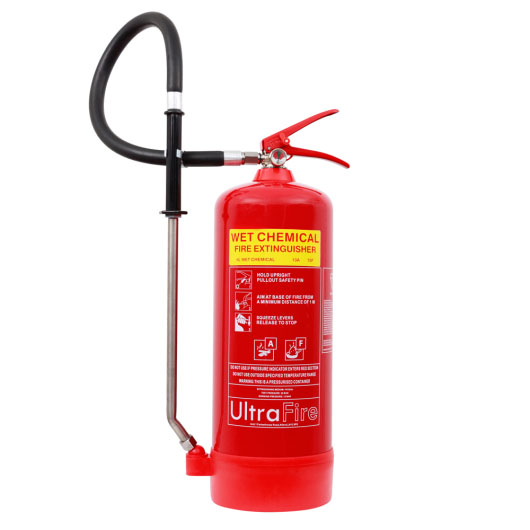
Wet chemical extinguishers discharge a potassium solution through a long lance applicator. The lance lets you apply the agent from a safe distance. The chemical cools the burning oil rapidly, and it reacts with the surface through a process called saponification, forming a soapy layer that seals the oil and stops it reigniting. That reignition risk is the critical issue. CO2 extinguishers can disturb the burning surface and spread the fire. Foam and powder extinguishers aren’t rated for class F. Wet chemical extinguishers are the only correct extinguishing methods for cooking oil fires.
When to Leave It to the Fire Service
If the fire extends beyond a single pan, or if there’s any doubt about your safety, leave. No property is worth your safety, and class F fires escalate faster than most people expect.
What Is a Class F Fire Extinguisher Used For?
Matching the Right Extinguisher to the Hazard
A class F fire extinguisher is used specifically for fires involving cooking oils and fats. It’s the correct and required choice anywhere high-temperature oil cooking takes place, whether that’s a restaurant kitchen or a domestic hob.
Fire extinguisher types span all the main fire classes, and they’re not interchangeable. A CO2 extinguisher handles electrical equipment fires. A foam extinguisher tackles flammable liquid fires. But the fire extinguisher for class F fire use is specifically the wet chemical model. Nothing else carries a class F rating, and nothing else addresses the reignition risk.
Class F Fire Extinguisher Colour: How to Spot One Quickly
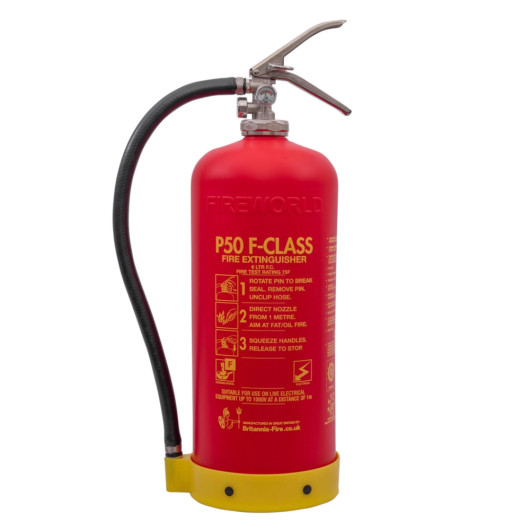
In the UK, all fire extinguishers have a red body as standard. The class F fire extinguisher colour identifier is a yellow (cream) label or panel, in line with BS EN 3. Could you spot one quickly in a crisis? It’s worth checking where yours is mounted before you ever need to reach for it.
Class F Fire vs Class K: Clearing Up the Confusion
Class F fire vs class K is a common source of confusion, particularly for businesses sourcing equipment internationally. Class K is the North American equivalent of class F, used in the US and Canada under NFPA standards. Both cover cooking oils and fats, but they’re tested and certified to different standards. In the UK, always look for a class F rating on the extinguisher label.
Choosing the Right Size Class F Fire Extinguisher
The right class F fire extinguishers for your setting depend on the scale of cooking. A 2-litre wet chemical model suits a smaller kitchen. A 6-litre model is standard for a commercial kitchen with a full deep fat fryer setup. The F number on the label tells you the size of the test fire it was rated against: a higher number means greater capacity.
If you’re not sure which size fits your kitchen, we’re happy to help you work that out.
Class F Fire Resistance: What Kitchen Surfaces Can’t Protect Against
When people search for class F fire resistance, they’re usually asking whether standard kitchen materials can withstand a class F fire. The short answer: not reliably. Class F fires burn at extreme temperatures. Steel surfaces conduct heat rapidly, and plastic components in kitchen equipment can degrade quickly. This is exactly why a class F cooking oil fire extinguisher positioned within reach of the cooking area isn’t an exercise in ticking boxes. It’s a genuine safety requirement.
We stock a range of class F fire extinguishers for both domestic and commercial kitchens, with options at every capacity.
How to Avoid Class F Fires
Building Better Kitchen Habits
Preventing a class F fire starts with awareness and comes down to consistency. Most class F fires are avoidable, and the steps to prevent them aren’t complicated.
Good prevention comes down to a few non-negotiable habits:
- Never leave oil unattended on heat. This is the most important rule in any kitchen.
- Use thermostat-controlled cooking equipment. In commercial kitchens, check thermostats regularly and have fryers serviced on schedule.
- Keep oil levels within the marked safe range. Overfilling leads to oil displacement and rapid temperature rise.
- Clean cooking equipment on a regular basis. Fat build-up in ovens and extractor hoods is a consistent and preventable fire risk.
- Fit a heat alarm above cooking areas. Heat alarms respond to temperature rather than smoke, so they are less likely to trigger from normal cooking while still providing warning of a fire.
- Train everyone who works in the kitchen. Staff should know where the extinguisher is, what to do and when to leave rather than fight the fire.
We offer fire risk assessments and BAFE-certified fire extinguisher servicing to help you meet your obligations and keep your team safe.
All information correct at time of posting.