Wednesday 29th April 2026
Most people walk straight past a fire extinguisher without a second glance. It’s only when you’re standing in front of one, needing it, that you realise you have no idea which one to grab or how to use them. This guide answers exactly that. How many different types of fire extinguishers are there? Six, and they have their uses in very different scenarios.
Here’s the thing: fire extinguishers are not interchangeable. Using the wrong type on the wrong fire can make things considerably worse, and in some cases (water on an electrical fire, for instance) genuinely dangerous. In the UK there are six different types, each built for specific fire risks. Consider this your no-nonsense guide to knowing your CO2 from your wet chemical, and why it actually matters.
- How Do Fire Extinguishers Work?
- Water Fire Extinguishers
- Foam Fire Extinguishers
- CO2 Fire Extinguishers
- Powder Fire Extinguishers
- Wet Chemical Fire Extinguishers
- Lithium-ion battery extinguishers
- How Many Fire Extinguishers Do I Need?
- Fire Extinguishers Explained
- Choosing the Right Extinguisher
How Do Fire Extinguishers Work?
At their most basic, fire extinguishers work by removing one or more elements from the fire triangle. Fire needs three things to keep burning: heat, fuel and oxygen. Take away any one of those and the fire goes out.
Every extinguisher is a pressurised cylinder containing an extinguishing agent. Pull the safety pin, squeeze the handle, and that pressure forces the agent out through a nozzle or horn. Simple enough in principle, but the agent inside determines which fires the extinguisher can tackle safely and which it should never go near.
Different types tackle the fire triangle in different ways. Some cool the fire down, while others smother it or interrupt the chemical reaction keeping it alive. That’s what makes each type distinct and why knowing the difference matters more than most people realise.
Water Mist Fire Extinguishers
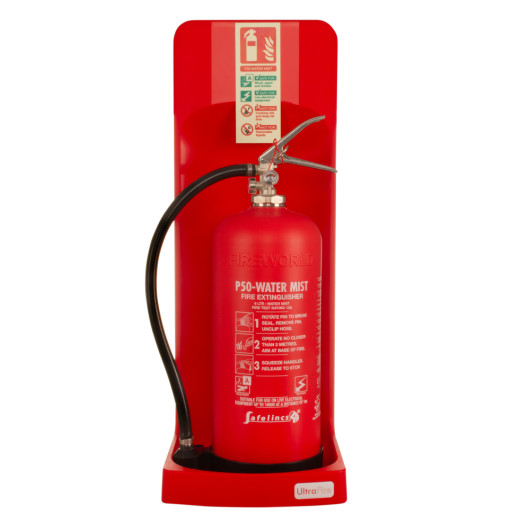
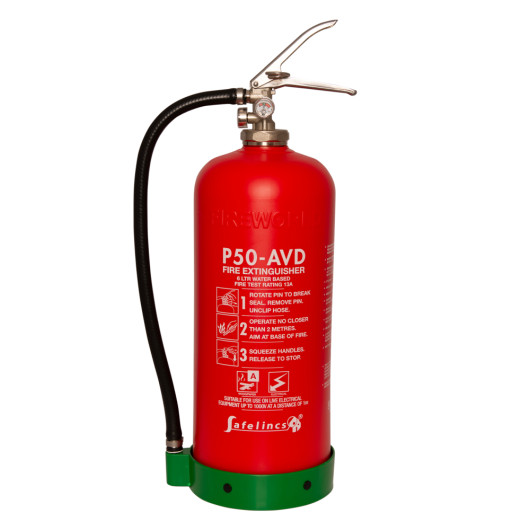
Water mist extinguishers are a modern evolution of the traditional water extinguisher and arguably the most versatile type on this list. Same red body, but the technology inside is a significant step forward. They’ve become increasingly popular in care homes, hospitals, schools and commercial kitchens, and it’s easy to see why.
How Do Water Mist Fire Extinguishers Work?
Rather than a solid jet of water, water mist extinguishers release an ultra-fine mist of microscopic droplets. This increases the surface area in contact with the fire, cooling it faster while simultaneously displacing oxygen around the flame. The droplets are so fine that the mist is safe to use around electrical equipment up to 1000V.
What Can Water Mist Fire Extinguishers Be Used On?
Water mist extinguishers handle Class A fires (solid materials) and Class F fires involving cooking oils and fats. That combination is what sets them apart from standard water extinguishers and makes them such a practical choice in environments where multiple fire risks are present. Their suitability near live electrical equipment up to 1000V makes them incredibly versatile.
Shop Water Mist Fire Extinguishers
Foam Fire Extinguishers
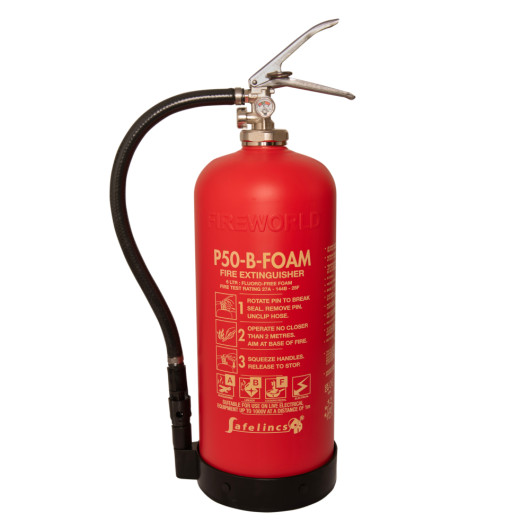
Foam extinguishers are a versatile option, identifiable by their red body and cream-coloured panel. However, water mist extinguishers are generally the preferred recommendation in most environments. They offer comparable versatility without leaving any residue to clean up, and unlike foam, they won’t cause damage if deployed near food or on delicate fabrics.
Foam remains a capable choice for workshops and commercial premises where multiple fire risks are present, but if you’re looking for a single extinguisher that covers everyday risks with minimal collateral impact, water mist is usually the better answer.
What Are Foam Fire Extinguishers Used For?
Foam works by forming a blanket over the burning material, sealing off oxygen and preventing flammable vapours from escaping and re-igniting. There’s a cooling effect too, which makes them effective on two fronts at once. Think of it as smothering and cooling simultaneously, which is a combination that makes them particularly reliable on liquid fires.
What Can Foam Fire Extinguishers Be Used On?
Foam extinguishers are rated for Class A fires (solid materials) and Class B fires covering flammable liquids like petrol and paint. That dual rating is what makes them such a practical choice where both fire risks coexist.
Foam extinguishers are usually suitable for use on live electrical equipment. Look for the dielectric test symbol on the front of the extinguisher to confirm this. Like water extinguishers, they should never be used on Class F fires involving cooking fats.
Shop Foam Fire Extinguishers
CO2 Fire Extinguishers
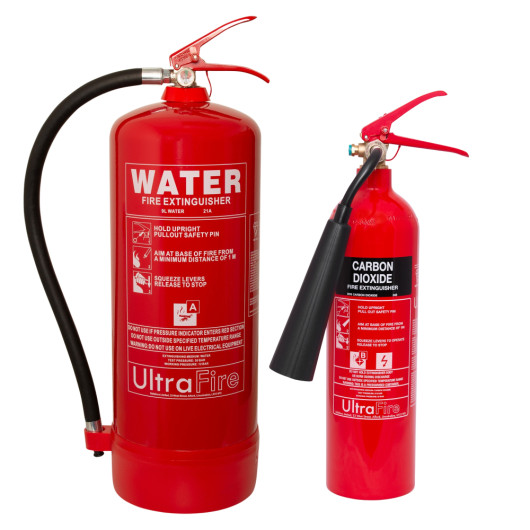
CO2 extinguishers are the clean, no-mess option. They are identifiable by their red body, black panel and distinctive hard horn rather than a standard nozzle. They are the best choice for anywhere with equipment that needs protecting, such as server rooms and offices as they leave no residue or damage.
What Can CO2 Fire Extinguishers Be Used On?
CO2 works by displacing the oxygen around a fire. Carbon dioxide is heavier than air, so it floods the area and suffocates the flames. CO2 extinguishers are rated for Class B fires (flammable liquids) and are the go-to choice for electrical fires, covering server rooms, computer-filled offices and control rooms among others.
They’re not suitable for Class A fires, as without cooling the burning material, solid fuels can re-ignite once the CO2 disperses. Worth keeping in mind if your risk assessment covers both.
A note on safety
CO2 displaces oxygen for humans as well as fires. In small or enclosed spaces, ensure ventilation after use. The horn also gets extremely cold during discharge, so always grip the insulated handle to avoid cold burns.
Shop CO2 Fire Extinguishers
Powder Fire Extinguishers
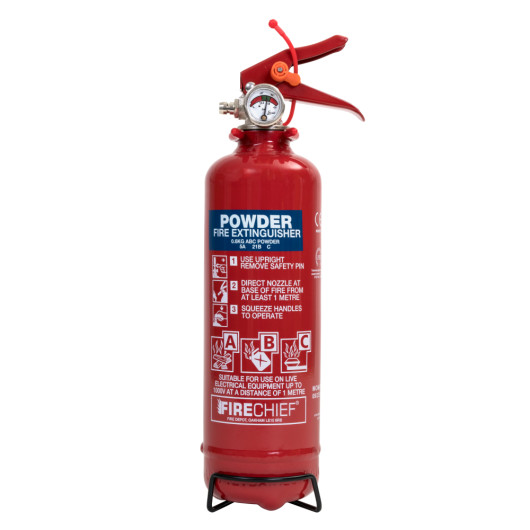
Powder extinguishers (often called ABC or dry powder extinguishers) are the broadest spectrum type available. Common in vehicles and outdoor spaces, you can quickly identify a powder extinguisher via its red body and blue panel.
What Are Powder Fire Extinguishers Used For?
The powder interrupts the chemical chain reaction that sustains a fire, breaking the process at a molecular level. It’s a different mechanism to cooling or smothering and it’s what gives powder its unusually wide coverage.
Dry powder extinguishers handle Class A, Class B and Class C fires. Class C covers flammable gases like LPG and natural gas, making powder one of the few types suitable for gas fires. That’s why you’ll find them in industrial environments and on commercial vehicles.
The catch? Powder is messy. It obscures visibility during use and can cause breathing difficulties in enclosed spaces. Think of it as the sledgehammer of fire extinguishers: devastatingly effective, but not remotely subtle. For most indoor settings it isn’t the first choice despite its range.
Shop Dry Powder Fire Extinguishers
Wet Chemical Fire Extinguishers
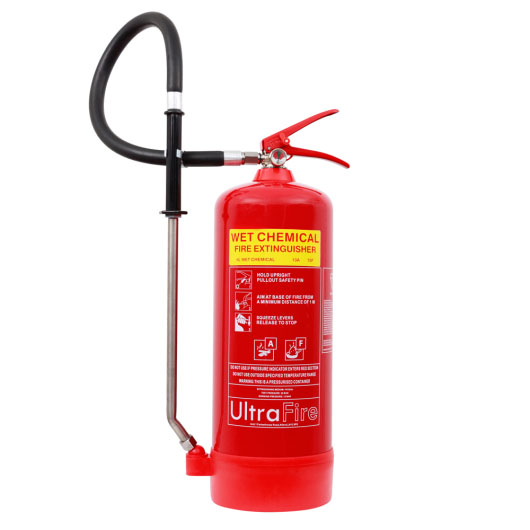
With a red body and yellow panel, wet chemical extinguishers are the specialist option. If you run a commercial kitchen, they’re non-negotiable. They exist specifically to tackle a type of fire that most other extinguishers simply cannot handle safely: burning cooking oil.
What Are Wet Chemical Fire Extinguishers Used For?
Wet chemical extinguishers work in two ways at once. The potassium-based solution reacts with burning oil to create a soapy foam layer, sealing the surface and cutting off oxygen. Simultaneously it cools the oil rapidly, reducing the risk of re-ignition once the fire is out. It’s a precise solution to a genuinely hazardous fire type, such as chip pan fires and deep fat fryers.
What Can Wet Chemical Fire Extinguishers Be Used On?
Wet chemical extinguishers are rated for Class F fires (burning cooking oils and fats) which is their primary purpose. Many models also cover Class A fires, making them a practical dual-purpose choice in kitchen environments where solid material fires are also a risk.
Outside that scope, they’re not the right tool for flammable liquids, though most Class F extinguishers are suitable for use on live electrical equipment, as they are designed for use on electrical cookers. In a kitchen setting that’s rarely a problem, but it’s worth knowing the limits before you need to act on them.
Shop Wet Chemical Fire Extinguishers
Class L fires: lithium-ion battery extinguishers
As lithium-ion batteries become increasingly common in everything from electric vehicles to e-bikes, scooters, and portable electronics, a new category of extinguisher has emerged to tackle the specific hazard they present. Class L extinguishers are designed for lithium-ion cell and battery fires, where conventional agents are largely ineffective and can sometimes make the situation worse.
Lithium-ion battery fires burn at extremely high temperatures and are prone to thermal runaway, a self-sustaining reaction that can cause a battery to repeatedly re-ignite even after it appears to have been extinguished. Class L extinguishers use specialist agents formulated to cool the battery cells rapidly and suppress this process.
These extinguishers are particularly relevant anywhere lithium-ion batteries are stored, charged, or used in significant quantities, including EV charging points, e-bike storage areas, warehouses handling battery-powered equipment, and premises with large numbers of portable devices.
Shop Lithium-Ion Battery Fire Extinguishers
How Many Fire Extinguishers Do I Need?
The honest answer is that it depends on your premises, the fire risks present and the layout of the building.
Under the Regulatory Reform (Fire Safety) Order 2005, businesses in England and Wales must carry out a fire risk assessment and provide appropriate firefighting equipment. British Standard BS 5306-8 gives more specific direction: as a general rule, at least one 13A-rated water or foam extinguisher per 200 square metres of floor space, with a minimum of two extinguishers per floor.
That’s a starting point, not a formula. A commercial kitchen with deep fat fryers or significant oil-based cooking needs wet chemical, while a server room needs CO2. The types and quantities should reflect the actual risks in your specific environment, which is exactly why a proper fire risk assessment matters.
Unsure where to start? Our team at Safelincs can help you work through it with a fire extinguisher site survey, or you can use our fire risk assessment tools for a clearer picture.
Fire Extinguishers Explained
Not sure which type you need at a glance? This table covers all six types, the fire classes they handle and where they’re best placed. The amber entries are the ones worth paying attention to; they flag the conditions and limitations that catch people out.
| Type | Panel colour | Class ASolids | Class BLiquids | Class CGases | Class FCooking oils | Electrical | Best for |
|---|---|---|---|---|---|---|---|
| Water | Red | Yes | No | No | No | No | Offices, warehouse, retail |
| Water mist | Red | Yes | No | No | Yes | Up to 1000V | Care homes, hospitals, kitchens |
| Foam | Cream | Yes | Yes | No | No | If tested | Garages, workshops, mixed risks |
| CO2 | Black | No | Yes | No | No | Yes | Server rooms, offices, electrical |
| Dry powder | Blue | Yes | Yes | Yes | No | Limited | Industrial, vehicles, outdoor |
| Wet chemical | Yellow | Many models | No | No | Yes | No | Commercial kitchens, deep fat fryers |
Choosing the Right Extinguisher
The right extinguisher comes down to the fire risks in your specific environment. For most offices and homes, a water mist or foam extinguisher covers the majority of likely scenarios. Add a CO2 where electrical equipment is present. If you have a kitchen with deep fat fryers, a wet chemical extinguisher is essential.
Safelincs stocks a full range of fire extinguishers from leading manufacturers, including service-free models that cut ongoing maintenance costs without compromising on safety. All products meet UK standards, so you can buy with confidence knowing they’ll perform when it matters most.
Still wondering how many different types of fire extinguishers there are and which one is right for your building? Our UK-based customer service team are on hand to help, whether you’re kitting out a single office or managing fire safety across a large estate. Get in touch and we’ll be happy to answer any questions you may have.
All information correct at time of posting.