Wednesday 6th May 2026
Estimated reading time: 8–10 minutes
Fire safety for restaurants is harder to get right than most people expect. Class F cooking oil fires behave differently to almost every other type of fire, and the wrong extinguisher won’t just fail to work. It can make things significantly worse. This guide walks you through what actually matters when choosing from our range of wet chemical fire extinguishers, so you can buy with clarity rather than guesswork.
What specific features should you look for in fire safety equipment for restaurants?
Not all extinguishers are built for the same job. In a commercial kitchen, choosing the wrong one isn’t just a wasted purchase. It’s a safety risk. Here’s what to check before you commit.
✓ Class F certification
This is the one thing you can’t compromise on. Class F fires involve burning cooking oils and fats: the kind that erupt from deep fat fryers and pans at temperatures of around 340°C. Only extinguishers with a confirmed Class F rating are designed to handle these fires. A general-purpose extinguisher won’t cut it. Under the Regulatory Reform (Fire Safety) Order 2005, if your fryer holds more than three litres of oil, a Class F wet chemical extinguisher is a legal requirement.
✓ The right size for your kitchen
A 6-litre wet chemical extinguisher is the right call for most commercial restaurant kitchens with multiple cooking appliances or deep fat fryers. A 2-litre or 3-litre unit works for smaller settings: catering vans, food stalls or compact canteens. Undersizing is one of the most common mistakes people make, and one of the most dangerous.
✓ A long application lance
Check that the extinguisher comes with a lance rather than a standard nozzle. The lance lets you lay the wet chemical agent down as a foam blanket directly onto the burning oil. Without it, you risk splashing the fire and spreading it. Always confirm this before you buy.
✓ Class A coverage as well as Class F
A good wet chemical extinguisher will also carry a Class A rating. That means it can tackle fires involving wood, paper and cardboard: waste bins, storage areas, the parts of your restaurant that aren’t near a hob.
✓ BS EN3 compliance and CE or UKCA marking
Any extinguisher for commercial use in the UK needs to conform to BS EN3. Look for CE or UKCA marking on the product. All Class F extinguishers must also conform to British Standard BS 7937. Without these markings, you could find yourself exposed during an insurance claim or a fire safety inspection.
✓ A commissioning option
In a commercial setting, extinguishers should ideally be commissioned on-site by a BAFE-certified engineer after installation. This is important for insurance purposes. Check whether your supplier offers this as part of the purchase. Many don’t.
✓ Clarity on servicing
Under the Regulatory Reform (Fire Safety) Order 2005, fire extinguishers in commercial premises need annual servicing by a competent person. Think about whether traditional annual servicing suits your operation, or whether a service-free option like a P50 extinguisher would work out better for you.
How do wet chemical fire extinguishers compare for restaurant fire safety?
There are several options to consider, and the differences between them are worth understanding.
The 6-litre UltraFire Wet Chemical Extinguisher is the go-to for most commercial kitchens. It carries a solid Class F rating, handles deep fat fryer fires confidently, and it’s available on its own if you already have a fire blanket sorted.
If you’d rather get everything in one go, the 6-litre Wet Chemical and Fire Blanket Special Offer pairs that same extinguisher with a 1.0m x 1.0m Kitemarked fire blanket. It’s a sensible combination. Those two items cover the most important bases for first response in a kitchen.
Running a restaurant where electrical equipment is also a concern? Tills, refrigeration units, kitchen appliances: the 6-litre Wet Chemical, 2kg CO2 and Fire Blanket Special Offer adds a CO2 extinguisher into the mix. It’s a good option for anyone who wants broader coverage without buying separately.
Then there’s the Britannia P50 Wet Chemical. This one stands apart. Its composite construction means you only need an annual visual check by someone on your own team, not a third-party engineer. Many organisations save over 50% on their extinguisher costs over the guaranteed ten-year lifespan. It also carries strong fire ratings, so a single unit can often replace multiple traditional extinguishers on site.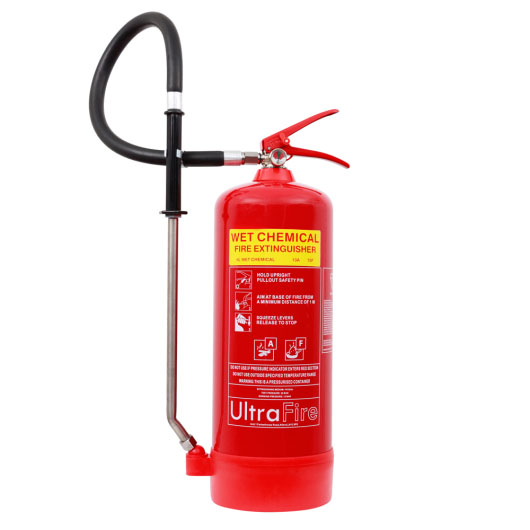
Which extinguisher is best for different types of restaurant or catering environment?
The 6-litre UltraFire and the 6-litre combination bundles suit full-service restaurants, pub kitchens and hotel restaurants best. Anywhere running multiple fryers or high-volume cooking equipment. The Class F risk is highest in these environments, and 6 litres gives you the capacity to meet it.
The Britannia P50 Wet Chemical is the smart choice for restaurant groups, chains or multi-site operators. The servicing savings compound quickly when you’re managing multiple locations. It’s also worth considering if reducing waste and environmental impact matters to your business.
Running a smaller operation? The 3-litre wet chemical extinguisher suits cafes, fast food outlets and food stalls well. The 2-litre model works for even smaller settings: catering vans and compact canteens. The hazard is smaller, but you still need a Class F-rated unit. Don’t skip it.
The Safelincs Kitchen Safety Kit is a practical starting point for smaller catering environments and managed properties. Everything you need in a single purchase.
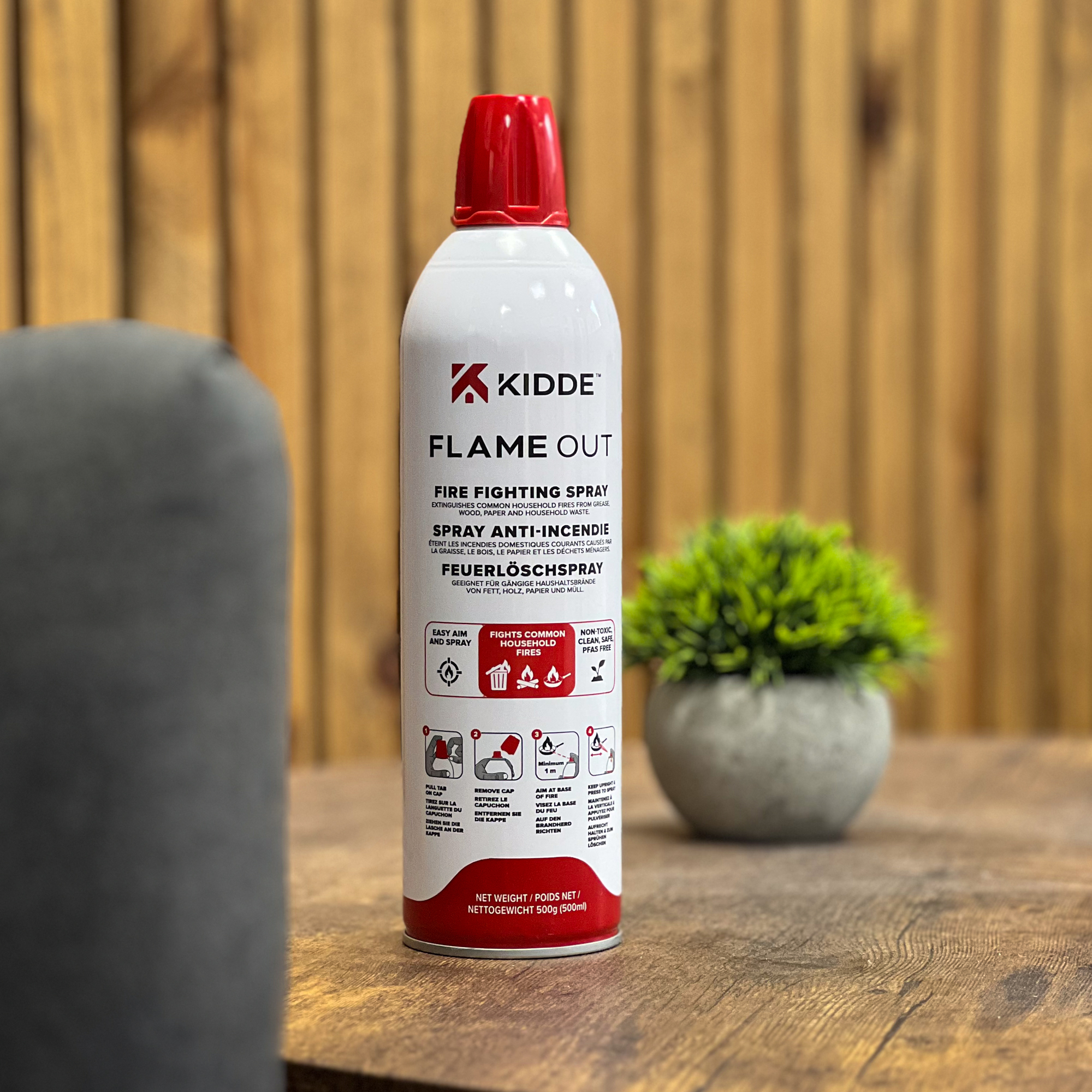
For domestic situations: a restaurant owner’s home kitchen or a home-based catering setup, the Kidde Flame-Out compact extinguisher is a lightweight aerosol option for small grease, wood and household waste fires. The Safelincs Home Safety Kit gives you broader home fire detection and suppression in one purchase.
What alternatives to wet chemical extinguishers are worth looking at for restaurant fire safety?
Wet chemical extinguishers are the right foundation for any commercial kitchen. But no single product covers everything you need.
Fire blankets are the most practical addition. They’re inexpensive, they don’t need any training to use, and they work well on small pan fires and clothing fires. Mount one on the wall away from the cooking area so it’s always reachable. Every kitchen should have one.
CO2 extinguishers cover your electrical risks: the bar area, front-of-house equipment, kitchen panels and EPOS systems. They sit alongside a wet chemical unit rather than replacing it. Most restaurants need both.
Water mist extinguishers are certified for small Class F fires in domestic settings, but we don’t recommend them as a replacement for wet chemical in a commercial kitchen. Our own independent research supports limiting water mist to fires no larger than a domestic deep fat fryer, roughly a 5F rating. A busy restaurant kitchen needs more than that.
For a longer-term option, a fixed kitchen suppression system over the cookline gives you automatic detection and suppression right at the source. Portable extinguishers stay as backup. It’s worth exploring if you’re investing in a new kitchen build or a major refurbishment.
Browse our kitchen fire extinguishers range if you’d like a broader look at what’s available for cooking environments.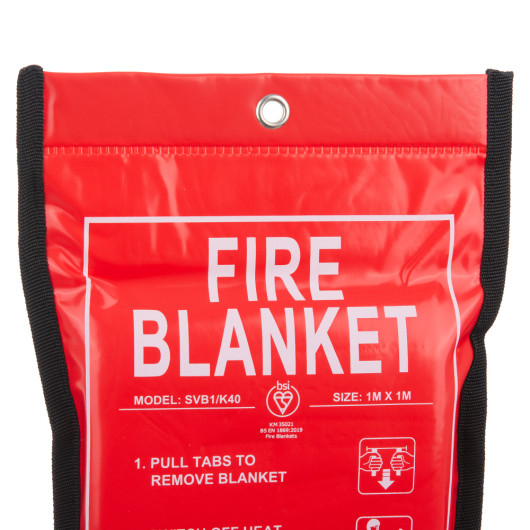
How do you spot a quality restaurant fire safety product?
| Green flags ✅ | Red flags 🚩 | |
|---|---|---|
| Certification | BS EN3 compliant; BS 7937 compliant for Class F; CE or UKCA marked; Kitemarked fire blankets | No visible certification; vague claims of “meets standards” with no detail |
| Fire class rating | Clear Class F rating on the label; Class A rating also shown | No Class F rating; generic “multi-purpose” labelling with no fire class breakdown |
| Application method | Extended lance included for low-pressure foam deployment | Standard nozzle only: not suitable for Class F cooking oil fires |
| Size guidance | 6-litre for commercial kitchens; 2 to 3 litre for small or domestic settings | No sizing guidance at all; one-size framing regardless of environment |
| Service requirements | Clear annual servicing guidance; P50 option available for visual-only inspection | No servicing information; nothing to confirm compliance with the Regulatory Reform (Fire Safety) Order 2005 |
| Supplier credentials | BAFE-certified commissioning available; UK-based support; clear product detail | No commissioning option; thin product information; returns policy unclear |
| Ready to use | Fully charged on delivery; wall bracket included; tamper seal intact | No wall bracket; safety pin or seal missing or damaged on arrival |
| Environmental compliance | Agent free from PFAS and PFOA chemicals, which have been prohibited in the UK since July 2025 | Older formulations containing PFOA, which has been prohibited in the UK since July 2025 |
Ready to get it sorted?
Good fire safety in a restaurant isn’t about covering yourself on paper. It’s about having equipment that actually works, fitted correctly and kept in the condition the law requires. We carry the full range of wet chemical extinguishers, combination bundles and supporting kit to protect a commercial kitchen of any size. We offer BAFE-certified commissioning, a best price guarantee and a UK-based team who know this stuff inside out. Whether you’re setting up for the first time or reviewing what you’ve already got, get in touch and we’ll point you straight to what your premises need.
All information correct at time of posting.