Thursday 14th May 2026
Estimated reading time: 7 minutes
Key takeaways:
- Class D fires involve combustible metals and behave unlike any other fire class.
- Water, foam and CO2 extinguishers can all make a class D fire significantly worse.
- Specialist dry powder agents are the only appropriate suppression method.
- Lithium-ion battery fires are not class D fires and require different equipment.
- Matching the right extinguisher to your specific metals is essential.
Most people have a rough idea about fire classes. Class A for wood and paper; Class B for flammable liquids. But what is a Class D fire? Class D sits in a different category entirely, and it’s the one most responsible persons never think about until they’re dealing with one. Class D fires involve combustible metals. They need a completely different response to any other fire type, and the wrong extinguisher won’t just fail; it can actively make the situation worse. This guide covers the class D fire definition, what causes them, which class D fire materials to watch for and how to extinguish a class D fire safely.
Shop our Thomas Glover 9Kg Metal Fire Powder Extinguisher for Class D fires.

What is a fire extinguisher class?
How the UK fire classification system works
Fire classes exist for one reason: to match the suppression agent to the fuel. Apply the wrong agent and you risk making the fire worse, or simply doing nothing useful at all. In the UK, fire classes follow the European standard EN 2, which organises fires by fuel type. Understanding how fire extinguisher types map to each class is the starting point for any sound fire protection plan.
The table below sets out the full classification system at a glance.
| Fire Class | Fuel Type | Typical Fuels |
|---|---|---|
| Class A | Solid materials | Wood, paper, textiles, most plastics |
| Class B | Flammable liquids | Petrol, diesel, paint, solvents |
| Class C | Flammable gases | Propane, butane, methane, acetylene |
| Class D | Combustible metals | Magnesium, sodium, titanium, aluminium powder |
| Class F | Cooking oils and fats | Chip pan oil, lard, deep-fryer fat |
There’s no Class E in the UK system. Electrical hazards aren’t a separate fire class; certain extinguisher types carry a specific safety rating for use near live equipment instead. Getting classes, colour coding, rating, location and maintenance right across your premises is a compliance requirement. If you’re uncertain which extinguishers belong where, a fire risk assessment will give you a precise, site-specific answer.
What are the common causes of class D fires?
Class D fire materials: which metals carry the highest risk?
The class D fire definition comes down to the fuel: a combustible metal. These are metals that can ignite and sustain a fire, particularly when they’re present as fine particles such as powder, swarf or thin shavings. Heat, air and moisture all play a role. And that last factor is where class D fires become especially dangerous; many combustible metals react violently with water, which is why the standard fire-fighting instinct can make things dramatically worse.
So what causes class D fires? Most incidents trace back to two or three contributing factors working together: metal dust and swarf accumulating in processing areas, friction and heat generated by machining or grinding operations, and inadequate storage of reactive metals near moisture or ignition sources. Understanding definition, causes and examples of class D fire materials helps you assess your specific risk before an incident occurs.
The metals most commonly involved in UK industrial settings include:
- Magnesium: Widely used in aerospace, automotive and medical device manufacturing. Magnesium swarf and powder are highly flammable. The most frequent example of class D fire in UK industry involves magnesium machining operations where fine particles build up around equipment.
- Sodium and potassium: Both react with moisture in the air and can self-ignite. Contact with water causes a violent chemical reaction.
- Titanium: Used in aerospace and precision engineering applications. Titanium dust ignites at relatively low temperatures and burns with intense, sustained heat.
- Aluminium powder: A class D fire example that appears in manufacturing, pyrotechnics and additive manufacturing environments.
- Pure lithium: A combustible metal in raw form. This is distinct from lithium-ion batteries, which behave differently entirely and are covered separately later in this guide.
- Zirconium: Present in specialist industrial and nuclear applications.
Preventing a class D fire starts well before any ignition event. Regular cleaning schedules, proper ventilation and controlled metal storage are the practical measures that reduce risk at source. They’re also far less costly than dealing with the consequences.
What colour code identifies a class D fire extinguisher?
Class D fire colour and class D fire symbol: how to spot the right extinguisher
All UK fire extinguishers share a red cylinder body. The colour coding refers to the panel or band on the extinguisher, identifying the suppression agent inside. It’s a quick visual system designed to work under pressure, in an emergency, when there’s no time to read a full label.
The class D fire colour is blue. But there’s an important distinction to make here. Standard blue-banded dry powder extinguishers (the type rated for Class A, B and C fires) look almost identical to a class D extinguisher but contain a completely different agent. They are not interchangeable. Using a standard dry powder extinguisher on a combustible metal fire is dangerous; the agent won’t suppress the fire and may scatter burning particles.
The class D fire symbol is a five-pointed star (★). You’ll find it displayed on the label alongside the letter D, confirming the extinguisher is rated for metal fires. When you’re scanning fire extinguisher colours across your site, the star symbol is the clearest confirmation you’ve found the right equipment.
Reading the full label matters more than checking the band colour alone. A trained eye can spot the difference quickly. An untrained one under pressure cannot. That’s an argument for clear signage and regular staff familiarisation, not just correct product selection.
What is a class D fire extinguisher?
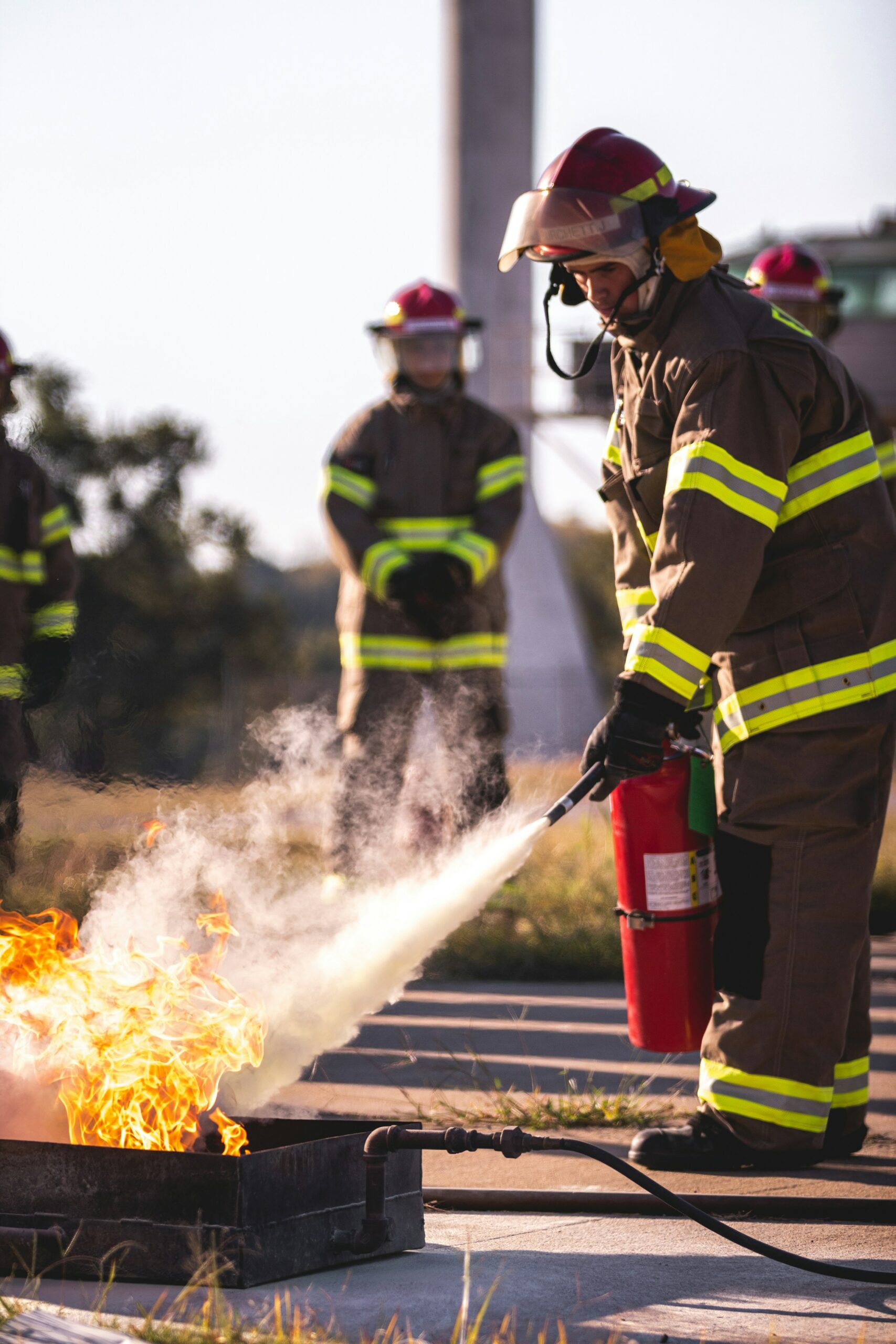
How class D extinguishers work and what makes them different
A class D fire extinguisher is a specialist piece of equipment designed exclusively for combustible metal fires. It contains a dry powder agent formulated to smother and cool burning metals without reacting with them. This is not standard ABC powder. The agent inside is a different product entirely.
Types of class D fire extinguisher powderClass D fire extinguisher powder varies by application, and matching the formulation to the metals on your site is non-negotiable. Different metals require different agents; there’s no single product that covers all combustible metal types. The main options include:
- Copper powder: Most commonly used on magnesium fires. It forms a heat-dissipating layer over the burning surface, starving the reaction of oxygen.
- Sodium chloride-based powder: Effective on sodium, potassium and other highly reactive metals.
- Graphite-based compounds: Used in specialist formulations for specific metal types.
- Ternary eutectic chloride (TEC) powder: A more versatile option covering a broader range of combustible metal types.
Choosing the right class D fire extinguisher for metal fires on your site means identifying which metals are present before you select a product. A supplier worth working with will ask you this question upfront; we do.
The class D fire rating on an extinguisher label tells you what size and type of metal fire the product has been tested against. Check that this rating reflects the volume of combustible material in your specific environment, not just the most common scenario.
The best class D fire extinguishers use a low-velocity applicator nozzle, and this detail matters more than it might seem. Burning metals are highly sensitive to disturbance. A high-velocity discharge scatters burning particles and spreads the fire. A controlled, low-pressure flow of agent builds coverage without agitation, which is exactly what you need.
What is a class D fire extinguisher used for?
Where class D extinguishers belong and how to use them
A class D fire extinguisher is used exclusively on combustible metal fires. It has no application on Class A, B, C or F fires. Using it elsewhere won’t give you effective suppression; it’s simply the wrong tool.
Sites where you’d typically expect to find a class D extinguisher: metal machining and grinding workshops, aerospace and automotive manufacturing facilities, university or commercial research laboratories handling reactive metals, pharmaceutical production environments and additive manufacturing sites using metal powders. These are environments where combustible metals are processed, stored or machined as a core part of daily operations.
How to use a class D fire extinguisher: step-by-step
Knowing how to identify and extinguish class D fires in these settings is part of a broader emergency response plan, and it hinges on the people on the ground. Anyone working around combustible metals needs specific training, because the instinctive response (grabbing the nearest extinguisher or reaching for water) can transform a manageable fire into a serious incident.
On how to use a class D fire extinguisher: operate from the distance stated on the label. Apply the powder gently, with a steady side-to-side motion to build coverage across the burning material. The key is control, not force. Once the fire appears to be out, leave the powder layer undisturbed until you’re certain the metal has fully cooled; reignition is a real risk, and disturbing the layer too soon can restart the fire.
After any metal fire incident, call the fire service, even if you believe the fire is out. That’s best practice for incident management, not overcaution.
Which category of fire does flammable gas come under?
Class C fires and how they differ from class D
Flammable gas falls under Class C. This covers gases such as propane, butane and acetylene. Class C fires are typically addressed with dry powder extinguishers, though the priority is almost always to isolate the fuel supply before attempting suppression. Extinguishing a gas fire without shutting off the supply leaves unburnt gas accumulating, which creates an explosion risk rather than a resolved incident.
Gas is Class C. Combustible metals are Class D. They’re distinct hazards requiring entirely different equipment and response plans. The confusion between the two is understandable; they’re adjacent classes, both involving rapid, high-heat combustion. But the differences in suppression approach couldn’t be more significant, which is why correct labelling and trained staff matter so much when something goes wrong.
Can water be used on a Class D fire?
Why water makes a class D fire worse, not better
No. Water must never be used on a class D fire. This is one of the key aspects of class D fires that separates them from almost every other fire type, and it’s the aspect that causes the most harm when misunderstood.
Many combustible metals react violently with water. Sodium and potassium generate hydrogen gas on contact with water and can ignite explosively. A magnesium fire fed with water becomes more intense. What looks like a sensible intervention can rapidly turn a contained incident into something far more dangerous.
Tackling a class D fire with any of the following agents will worsen the situation rather than control it:
- Water: Reacts violently with most combustible metals, generating hydrogen gas and intensifying the fire
- Foam: Water-based by composition and equally reactive with combustible metals
- CO2: Can cause burning metal to scatter, spreading the fire to surrounding areas
- Standard ABC dry powder: Not formulated for metal fires and won’t provide meaningful suppression
Only an appropriate class D agent should be used. Knowing how to detect and extinguish a class D fire (combustible metals) correctly, with the right equipment already in place, is what separates a controlled incident from a serious injury.
If you don’t have a suitable class D extinguisher and the fire is still small, evacuate, close doors behind you and call 999. Don’t improvise. How to extinguish a class D fire safely depends entirely on having the right product in place before an incident occurs.
What’s the difference between class D and lithium-ion battery fires?
Class D vs lithium-ion fires: two hazards, two different solutions
This is a genuinely common source of confusion, and it has real consequences for equipment selection.
Pure lithium is a combustible metal and falls under Class D. Lithium-ion batteries, by contrast, don’t burn metallic lithium. They undergo thermal runaway: a self-sustaining chain reaction where heat builds inside the cell, causing it to vent, catch fire and potentially explode. The chemistry is different, the behaviour is different and the correct suppression method is different.
Lithium-ion battery fires sit outside the EN 2 classification system as a distinct hazard category. They’re not class D fires. Water mist extinguishers are widely recommended for lithium-ion incidents because they cool cells rapidly and reduce the risk of reignition. Our E-Series water mist range is worth considering if your site has significant battery storage or EV charging infrastructure.
| Feature | Class D fire | Lithium-ion battery fire |
|---|---|---|
| Fuel type | Combustible metal | Lithium-ion cells in thermal runaway |
| Fire classification | Class D (EN 2) | No specific class; separate hazard category |
| Correct suppression | Class D specialist dry powder | Water mist |
| Water risk | Severe; never use water | Water mist (low velocity) can be effective |
| Reignition risk | High | Very high |
So what extinguisher should you use on Class D fires? A class D specialist dry powder extinguisher, matched to the specific metals on your site. For lithium-ion battery fires, the answer is a water mist extinguisher. Getting this distinction right is central to understanding causes, risks and how to tackle them across different types of premises.
Class D fires explained clearly is what this guide set out to do. If you need help choosing the right equipment for your specific situation or site, contact us here.
All information correct at time of posting.