Fire & Safety Solutions
CALL OUR TEAM NOW 0800 612 6537
Lines open today 8am - 6pm


Free Delivery
on 100s of Products
Secure Payments
with our fast checkout
Live Customer Chat
Available Now
30 Day Accounts
for Public Sector
5 Star Customer Feedback
Which Smoke Alarm is Best?
Smoke detector types
When choosing smoke alarms, it can be difficult knowing which alarm type is the right one for a particular room in your house, tenanted property or workplace. Manufacturers have developed several types of smoke detector sensors to suit different rooms and fire risks. Fitting the right type of detector in each room will ensure the alarm reacts as quickly as possible to the fire risk and reduce false alarms. Below you will find a list of rooms together with the types of smoke detectors you should fit and a brief explanation as to why.
There are four main smoke detector types; optical, ionisation, heat and multi-sensor (combined). The type of smoke alarm you fit will depend on which room the alarm is installed in, and the type of combustible material in these rooms.
Which Smoke Alarm do I Need?
Ionisation Smoke Alarms
Ionisation smoke detectors, also known as ionization smoke detectors, were traditionally used throughout properties however, ionisation smoke alarms contain a tiny radioactive source in the sensor chamber, and due to this, these types of smoke alarms are getting phased out. Optical smoke alarms are recommended as the best smoke alarm to replace an ionisation smoke detector.
Optical Smoke Alarms

Optical alarms are ideal for slow smouldering fires that can occur in living rooms
These are suitable for:
- Bedrooms
- Lounges / living rooms
- Dining rooms
- Hallways
- Landings
- Offices
Optical smoke alarms, also known as photoelectric smoke detectors, are less prone to false alarms than ionisation models and are slightly quicker at detecting slow smouldering fires that tend to produce a lot of smoke. This type of fire tends to originate from upholstery materials or overheated wiring. Optical smoke alarms' high sensitivity to large particles in the air means they have a quick response time to these types of smouldering fires. Optical sensing chambers effectively "see" when smoke is present, as the large particles block and cause the infrared light within the detector chamber to scatter.
Optical smoke detectors are suitable for installation in bedrooms and living rooms where soft furnishings and cables are commonplace. They can also be installed in downstairs hallways as they are significantly less likely than ionisation alarms to be triggered when cooking fumes are present from the kitchen. Optical smoke alarms are unsuitable for areas open to the elements or very dusty environments.
Read more about how optical smoke alarms work.
Heat Alarms
These are suitable for:
- Kitchens
- Garages
- Dusty environments
Heat alarms are triggered when the temperature inside the room reaches approximately 55°C so they do not sound false alarms from cooking fumes, vehicle fumes or steam.
Read more about how heat alarms work.
Multi-Sensor (Combined) Smoke Alarms
These are suitable for:
- Stairwells
- Landings
- Offices
- Bedrooms
- Lounges / living rooms
- Hallways
The main types of multi-sensor alarms are:
- Smoke and heat detectors – used for improved detection of fast-flaming fires and reduced risk of false alarms
- Smoke and CO detectors or heat and CO detectors – are used to detect fire and carbon monoxide, a deadly gas that human senses cannot detect. Read more about carbon monoxide poisoning. Although some combined alarms contain a heat sensor, they are not suitable for use in kitchen areas.
Read more about how multi-sensor smoke alarms work
Should I Buy a Battery- or Mains-Powered Smoke Alarm?
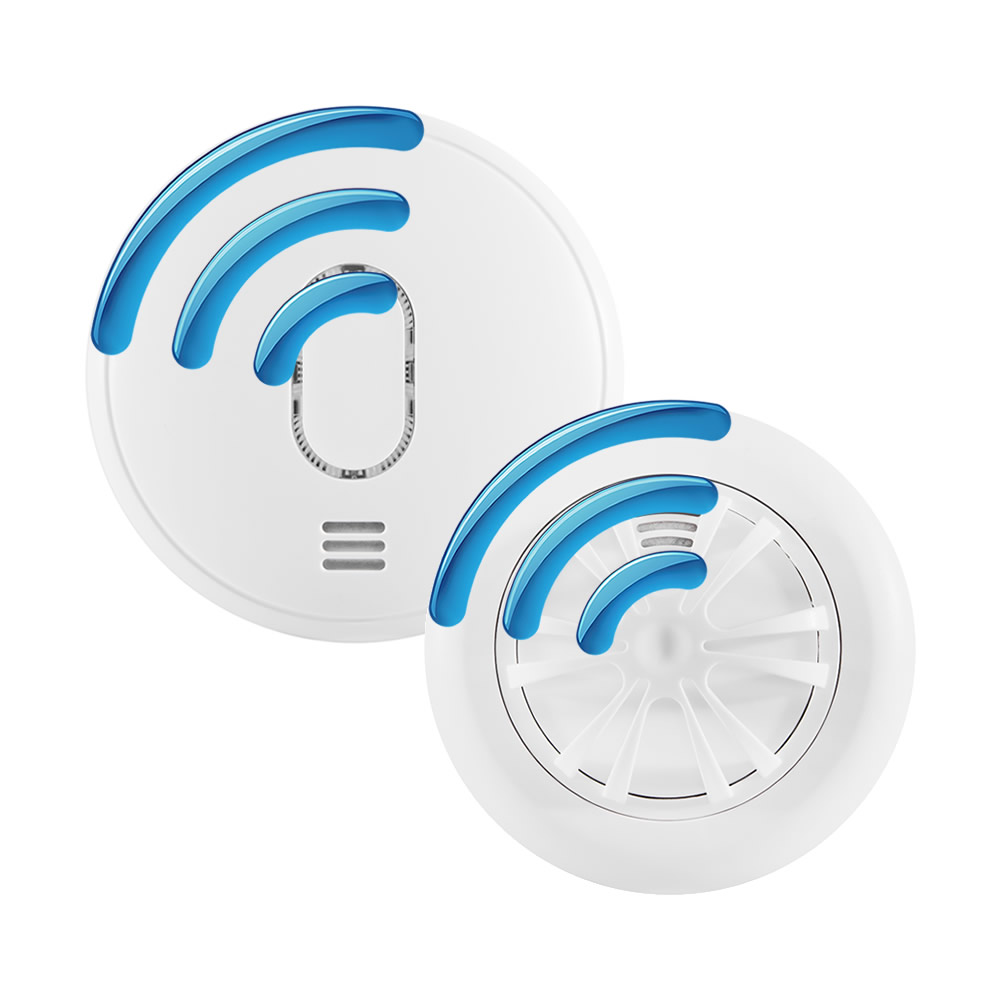
UltraFire radio-interlinked battery powered smoke and heat alarms
Choosing between buying mains-powered or battery smoke alarms will depend on your requirements and your budget. Mains-powered smoke detectors provide better protection, but you will need an electrician to install them, increasing your costs. Battery-powered radio-interlinked smoke alarms can link together in much the same way as a hard-wired system, so when one alarm detects fire all alarms sound.
Battery Types
There are two main battery type smoke detectors, alkaline and long-life lithium batteries. Each battery type has a different life length, and the kind of smoke alarm it is in will affect the battery life:
- Lithium batteries standard smoke alarm: 10 years
- Lithium batteries radio-interlinked: 2 - 5 years
- Alkaline batteries: 1 year
Which Mains-Powered Smoke Alarm Should I Buy?
Mains-powered smoke alarms can have a variety of backup battery types in them:
- Alkaline
- Lithium non-rechargeable
- Sealed-in lithium rechargeable
Mains smoke and heat alarms with an alkaline battery backup provide the cheapest solution. Depending on how often the alarms are tested and how often they activate (both real and nuisance alarms) the backup battery will last approximately 12-18 months before replacement is required. However, manufacturers recommend batteries are replaced every 12 months to ensure your smoke detector is always working and ready to detect a fire.
You can upgrade some mains-powered smoke alarms to non-rechargeable lithium backup batteries. These batteries are not sealed in the alarm, a lithium backup battery will last 5 to 10 years before replacement; except when used with radio-interlinked alarms, which can reduce the backup battery lifespan to 2-5 years. Not all mains-powered smoke alarms can be fitted with a non-rechargeable lithium battery, check the product manual to ensure your smoke alarm can work with this type of battery.
Finally, mains-powered alarms are available with a sealed-in rechargeable lithium backup battery. This battery is designed to last the life of the alarm (10 years) and cannot be tampered with during its lifespan. As well as saving costs from replacement, the sealed lithium battery option is ideal for rented properties where the removal of batteries or leaving them to run flat could be an issue.
How Are Mains-Powered Smoke Alarms Connected?
To obtain a mains feed, smoke detectors and heat alarms can be wired to the nearest lighting circuit or through a dedicated circuit from the distribution board. Power supply from the light fitting is generally preferred as it is more cost-effective and less likely to be
disabled to stop the "nuisance" of beeping alarms should the back-up battery run low, but care must be taken to ensure the light switch does not also cut power to the alarms.
What Do The Different Smoke Detector Grades and Categories Mean?
You will typically find the following smoke alarm grades and categories detailed in a fire risk assessment or relevant legislation:
- Domestic, owner-occupied housing: BS5839 Part 6, Grade F2, Category LD2
- Extensions of domestic, owner-occupied housing: BS5839 part 6, Grade D2, Category LD2
- Rented and let domestic properties: BS5839 part 6, Grade D1, Category LD2
- Blocks of flats or Houses in Multiple Occupation:
- Communal areas: BS 5839 Part 1 non-domestic fire alarm system or BS 5839 Part 6, Grade A, Category LD2 / L2
- Individual dwelling units: BS5839 part 6, Grade D1, Category LD1 or LD2, plus a sounder and heat detector connected to the communal area alarm system
- Businesses of any size attached to domestic dwelling(s): BS 5839 Part 1 non-domestic fire alarm system, plus a sounder and heat detector in the dwelling
Grades D and F were split into two parts in the 2019 update to BS 5839-6. The number 1 indicates the requirement for sealed, tamper-proof batteries and the number 2 is for user-replaceable batteries.
Grades D1 and D2
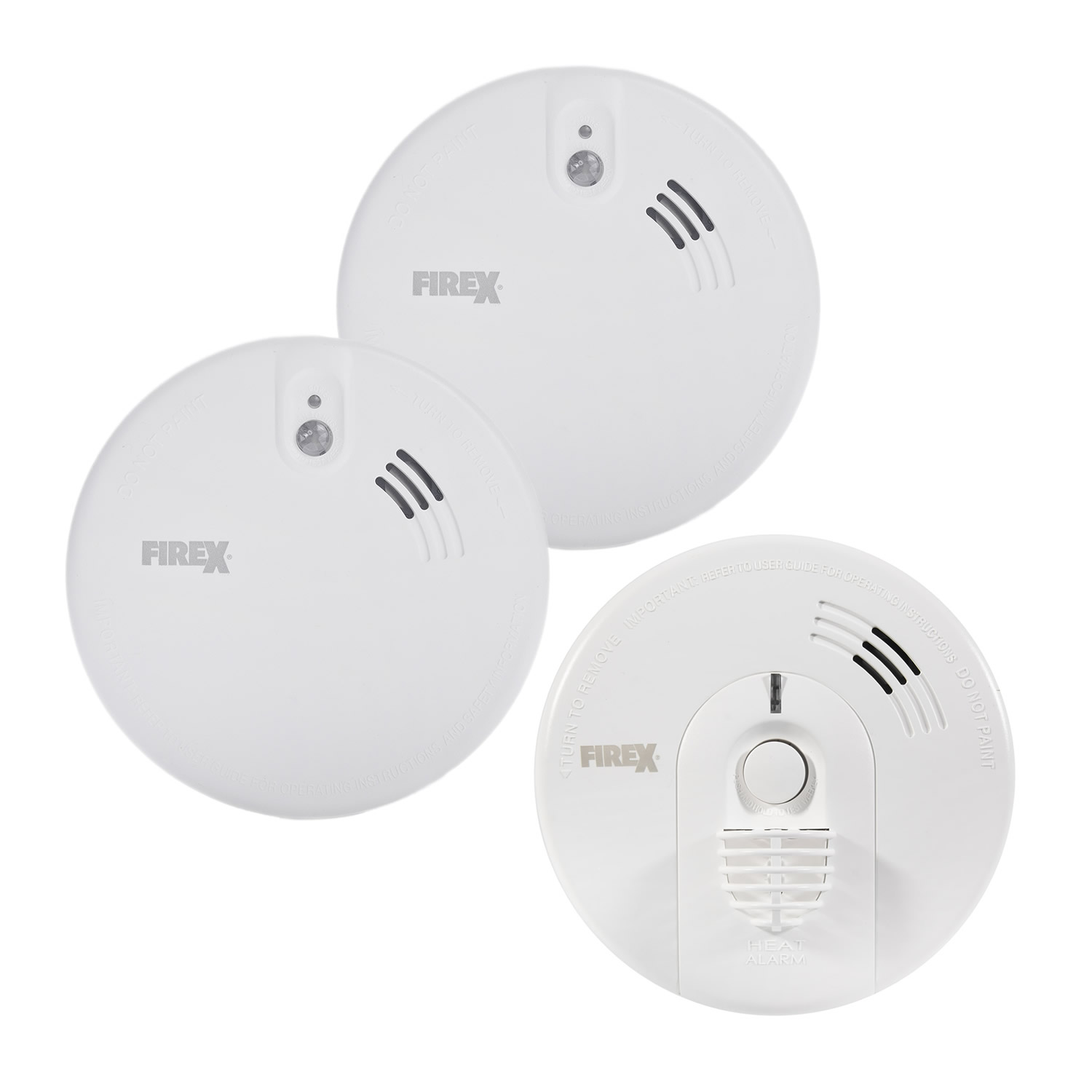
Kidde Firex KF Series suitable for Grade D2 installations
Mains-powered, interlinked smoke detectors and heat alarms. These are usually powered with a cable from the nearest light fitting as long as the light switch does not also cut power to the alarms. To create an interlink (all alarms go off at the same time in the case of a fire) they either require a cable connection between the units, separate from the power circuit, or a radio-interlink connection.
To conform to BS 5839 Pt 6 grade D1 and D2, mains-powered smoke detectors and heat alarms must have a backup battery and interlink with each other so that all alarms will sound when one detects a fire. In the event of a mains failure, the backup battery ensures that the alarm will continue to be powered until the mains feed is restored.
Some building control officers or local councils may accept Grade F1 alarms with radio-interlink in place of mains-powered alarms, but you will need to confirm this before starting work to ensure such alternative alarms are acceptable.
Grades F1 and F2
Battery-powered smoke detectors and heat alarms. This type of smoke detector is easily installed with minimal disruption and no need for an electrician. Most are standalone products but some may have wireless interlink capability via radio frequency, and a select few are available with hardwired interlink.
Please see our guide to BS 5839 Part 6 for more details about domestic alarms, or our summary of BS 5839 Part 1 for non-domestic premises.
What Do I Do After Buying My Smoke Alarms?
As soon as you receive your new smoke alarms fit them immediately. Only working smoke alarms can detect a fire and save lives!
- Follow manufacturer instructions for installation
- Use screws or an adhesive sticker pad to fit to ceilings (glue should not be used! It can seep into the alarm and affect how it works)
Where on The Ceiling Should I Position My Alarm?
Your smoke or heat alarm will have positioning instructions within the supplied user manual. However, as a general rule, smoke alarms should ideally be placed in the centre of the ceiling and at least 30cm (12 inches) away from walls and light fittings.
Will My Smoke Alarm Need Replacing?
Yes, most smoke alarms will need replacing after 10 years. With age, the sensors in your smoke and heat alarms become less sensitive, so it is important to renew them every 10 years to ensure that they are still working effectively.
How Do I Dispose of My Old Alarm?
Smoke and heat alarms can usually be recycled. Read more about how to dispose of old smoke alarms.
Free Reminder Service
Sign up for our free smoke alarm reminder service to receive text or email reminders to test your alarm and to be notified when you need to replace your batteries or alarm. Reminders can be cancelled at any time.
Recommended Reading
- Fire Prevention in the Home
- A Guide to BS 5839 Part 6 (domestic fire alarm systems)
- A Summary of BS 5839 Part 1 (non-domestic fire alarm systems)
- Updated Smoke and CO Alarm Regulations for Rental Properties
- New Regulations for Scottish Smoke and Carbon Monoxide Alarms
- Fire Safety for Holiday Lets
- Fire safety: Approved Document B Building regulation in England covering fire safety matters within and around buildings
- Fire Risk Assessment Guides: Fire safety law and guidance documents for business
Reviewed: 13/09/2023 (doc:36 V2.1). Our articles are reviewed regularly. However, any changes made to standards or legislation following the review date will not have been considered. Please note that we provide abridged, easy-to-understand guidance. To make detailed decisions about your fire safety provisions, you might require further advice or need to consult the full standards and legislation.