Legal Requirements for Defibrillators
There are now estimated to be about 10,000 defibrillators (AEDs) installed in locations across the UK. But what are the legal obligations for defibrillators and who needs to have one?
What is the current UK legislation for defibrillators?
Workplaces
Technically, there is no legal requirement for workplaces in the UK (with the exception of schools) to have a defibrillator. However, the updated British Standards BS 8599-1:2019+A1:2026 now specify that an AED should be available in workplaces with 5 or more people present (including staff, visitors and customers). The BS 8599-1 update also states that to support emergency response times, defibrillators should be accessible within 2 minutes - one minute to locate the device and another to prepare and deliver treatment. This means for larger sites, more than one AED should be available to reduce travel time. Whilst this British Standard is not a legal requirement, it is recognised as best practice to demonstrate compliance with HSE law.
Schools
The Department for Education announced that by the end of the academic year 2022/2023, all schools in England should have at least one AED on the premises.
Recognition of the importance of having an AED in workplaces, vehicles and community spaces is growing and there is pressure from many groups for further legislation to be considered.
Should you have a defibrillator at work?
Many businesses and public bodies identify the life-saving role of an AED, and it is now recognised by the British Standards as best practice for HSE compliance to have an AED in any workplace with 5 or more staff, visitors or customers present. According to the British Heart Foundation, 30,000 people each year suffer a cardiac arrest outside of hospital. Survival rates are shown to be 50-70% higher in these victims when a defibrillator is used within 5 minutes of collapse.

Defibrillators in the workplace
Does my workplace need an AED?
HSE outlines that to comply with the Health and Safety (First Aid) Regulations 1981, employers are not required to install a defibrillator (with the exception of schools that are now required by the Department of Education to have at least one AED on the premises). However, with British Standards now recommending AEDs as best practice, many workplaces are choosing to invest in a defibrillator. Evidence shows that survival from a cardiac arrest is far more likely when a defibrillator is close at hand and is used within a few minutes.
What are the employer's responsibilities?
If you are thinking about installing a defibrillator in your workplace, you would need to consider training, accessibility and maintenance requirements.
Defibrillator training for staff
HSE First Aid Regulations state "Where an employer decides to provide a defibrillator in the workplace, those who may need to use it should be trained. Training can provide additional knowledge and skills and may promote greater confidence in the use of a defibrillator1"
The level of training required may also depend on the type of defibrillator you choose to install. Semi-automatic defibrillators are designed for use by trained individuals or healthcare professionals. If you decide to install a semi-automatic AED, full training should be given to staff. Consider a group instructor-led training course to ensure full and comprehensive training to necessary staff.
Fully automatic defibrillators can be used with no prior training by the general public. However, staff may feel more confident when using the device and may deploy it quicker if training has been given. As well as instructor-led training courses, defibrillator training units and manikins can be purchased to replicate the actual device and provide hands-on experience. These can be combined with online courses to increase confidence with the device and speed of delivery.
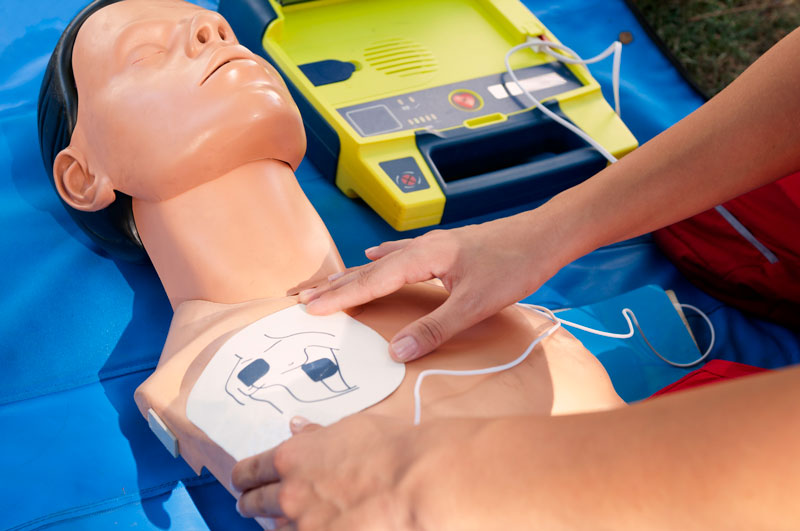
Maintaining a defibrillator in the workplace
As the speed of deployment of the AED is critical, a defibrillator should always be ready for use. The Responsible Person in your workplace should perform weekly visual checks on the device and keep a record of these checks. The batteries and pads have a 'shelf life' and 'stand-by life' so this needs to be monitored and replacements made when required. Full details can be found in the defibrillator maintenance guide.
Easy access to a defibrillator in an emergency
Defibrillators need to be found easily and accessible at all times. This can be a difficult balance with issues such as theft, misuse or vandalism. Consideration should be given to storing your AED to maximise accessibility in an emergency. For example, it's no use having a defibrillator in a locked cabinet if the person who knows the keypad code is out of the office.
Defibrillators and legal considerations
Some employers have concerns over the liability of anyone unsuccessfully administering a defibrillator. AEDs are sophisticated devices that have been designed to work automatically and therefore will not administer a shock if it is not required (even if a button is pressed). A person could only be liable for damages if intervention leaves the victim in a worse position than if no action had been taken. As noted by the Resuscitation Council, without a defibrillator, the recipient would certainly die and therefore it is difficult to see how it would be possible to make the situation worse.2 There have been no successful claims made against anyone wrongly administering a defibrillator.
References
- First aid at work: The Health and Safety (First-Aid) Regulations 1981 (Third Edition) 2013, Regulation 44, p 18
- The legal status of those who attempt resuscitation, The Resuscitation Council August 2010